Showing posts with label Pope Bl. John Paul II. Show all posts

Tuesday, April 10, 2012

On the Conspicuousness of Christians

I was recently instructed that, as a catechist, I should blend myself into my students, to make myself one of them, in order to make them accept me.  If I was too "different" or too blatant in my Catholicism, I would not be accepted.  Instead, I should work from within them, almost in an undercover way.  The thing is, it is difficult to be undercover when your students know you are teaching them the faith.  I can understand my professor's point: the members of the Church should integrate themselves into society so they can change it from within.  It is not an outside force that will bring change, but a force hidden within, such as hidden yeast leavens dough.  We are to be Trojan horses: we must sneak under their radar and then slowly purify their drinking water with the nectar of the faith.  The problem is this: I do not see this as an effective method.

I apologize if I am being proud: I am just giving my opinion on an issue that directly affects how I should live and teach.  If you have any ideas in this area, please tell me: perhaps your reasons will be more convincing to me than my professor's.

The main issue is that I find conspicuous Christians more the norm among the saints than yeast Christians.  I see more saints acting as armored knights than as wooden horses.  Think of the model of all Christians: Jesus Christ, the Son of God, risen from the dead.  He did not hide His faith: He drove the money-changers from the Temple, He performed miracles with countless witnesses, He preached day after day in the synagogues and the Temple (though His enemies were too cowardly to arrest Him then).  Some might say, "But He was God.  Surely God cannot hide Himself.  But we are only men!"  Have not men done the same, though?  Did not St. Paul rejoice over the countless sufferings he bore for preaching the Gospel openly?  He was even stoned to death in Derbe, yet He continued to preach.  Listen to the list of his troubles:

"Five times I have received at the hands of the Jews the forty lashes less one.  Three time I have been beaten with rods; once I was stoned.  Three times I have been shipwrecked; a night and a day I have been adrift at sea; on frequent journeys, in danger from rivers, danger from robbers, danger from my own people, danger from Gentiles, danger in the city, danger in the wilderness, danger at sea, danger from false brethren; in toil and hardship, through  many a sleepless night, in hunger and thirst, often without food, in cold and exposure" (2 Cor 11:24-27).

 Icon of St. Paul by Andrei Rublev

If he had merely kept his conversion secret and continued to act as the zealous Pharisee and pupil of Rabban Gamaliel that he was, or if he had remained an inconspicuous believer, would he have been put through so much suffering?  No!  But with all his suffering came conversions, countless, countless conversions.  If he were not so blatant in his faith, would he have converted so many?  I cannot say for sure, but I would assume not.

Think of the rest of the apostles as well: all except John the Theologian were martyred for their faith, even the thrice-denying one, Pope St. Peter.  "But they were apostles, personal friends of Christ!" some may respond.  Then recall all the countless martyrs of the early Church, such as the ones remembered in the Roman Canon:

"Ignatius, Alexander, Marcellinus, Peter, Felicity, Perpetua, Agatha, Lucy, Agnes, Cecilia, Anastasia."

Yet some might say, "those were still in the early Church.  Times changed, and so did our way of living the faith."  Does a change in culture mean we hide our faith?  By no means!  In extreme circumstances, some may be called to live underground in order to retain the faith from oppressive governments, but in general, we must not hide our faith: we should rather boast in the Lord!  The Church's record of conspicuous martyrs also does not end with the end of the Apostolic Age: martyrs have continued for centuries and centuries, and not only martyrs to the death, but martyrs to reputation, comfort, and fame.  Even in the past century, we have had Servant of God Óscar Romero, Bl. Jerzy Popiełuszko, Bl. Miguel Pro, and St. Maria Goretti.

 Servant of God Óscar Romero; Blessed Jerzy Popiełuszko

What about those who were not martyrs, but still lived their faith in the sight of all?  There are many: the mendicant orders of St. Dominic and St. Francis, pontiffs such as Leo XIII, Pope St. Pius X, and Servant of God Pope Paul VI (called a "white martyr" for the vicious response to his defense of sexual morality, Humanae Vitae), and workers with the poor such as Servant of God Dorothy Day and Bl. Mother Teresa of Calcutta.  Among the Russians, there is even a group called the yurodivuie, "fools for Christ's sake," such as St. Francis of Assisi, St. Benedict Joseph Labré, and St. Simeon the Holy Fool (St. Simeon Salos).  If the saints are any indication, Christians have never been known for their inconspicuousness.

That leads us back to the practical question: should we lived as conspicuous Christians or not?  In this way we would live not only in imitation of our Saviour Jesus Christ and His holy apostles, but in imitation of countless saints through the millennia.  Though our actions may seem foolish to the world, they are glorious to Christ, such as St. Isidore of Pelusium (St. Isidore Pelousiotes) wrote,

"Imitate the simple garments of Christ.  For if the roughness in apparel here on earth is foolishness, wearing the garment of light in heaven is certainly not" (Epistle 74).

We should not be afraid even if we must suffer for our conspicuousness.  As St. Gregory the Theologian exhorts,

"Teach in the temple, drive out the traders in divine things, be stoned if it is necessary you suffer this" (Oration 38.18).

St. Gregory the Theologian

Some may say that in doing this, in acting conspicuous, we are driving away those who would be converted by us.  We are showing the "radical" side of Christianity, which only a few are called to.  It is true that only some are called to the extent of martyrdom, but all are called to preach with their lives, if not also with their words.  Origen even says that it is better to preach with words we don't fully believe than to hide the faith in our hearts (vid. Exhortation to Martyrdom V).

In the end, is our faith one of private devotion, to be gently shared among others as a slowly creeping moss?  No!  Though some are called mainly to work, with direct preaching being rare, all are called to live openly and boldly for Christ.  As the axiom often mis-attributed to St. Francis of Assisi states, "Preach the Gospel at all times; when necessary, use words."  I believe I am called to be a catechist, though: I am called to be an example of the faith lived out for students to see.  When they see me, should they see a man who is only Christian in his intellect?  Should they not be able to tell if I'm a Buddhist well-trained in Catholic doctrine or a practicing Catholic?  Should they see me as no more than a neutral, politically correct textbook in human form?  By no means!

I will not hide my faith under a bushel basket.  When I teach, and even in general when I live, I will wear my faith on my sleeve (literally, in a sense, with my komboskini).  I will not hide my faith and water down my Christian life in order to appeal to the masses.  Should I dilute my Catholicism in order to convert others?  Then what am I converting them to but a crippled version of the faith, a version crippled by my "politically correct" witness?  Like the saints, who converted millions in their Christian zeal, I, too, will strive to live my faith as openly and zealously as possible in the hopes of converting my students.  The fight for conversion is a war, a war "not against flesh and blood, but against the principalities, against the powers, against the world rulers of this present darkness, against the spiritual hosts of wickedness in the heavenly places" (Eph 6:12).  It is a war of the City of God against the City of Man, as in St. Augustine's De Civitate Dei, a war of the culture of life against the culture of death, as in Pope Bl. John Paul II's Evangelium Vitae.  Some may be called to hide themselves amongst the enemy troops in hopes of gaining conversions, but I will be a warrior against the enemy, as the countless saints before me have been.  I will be a conspicuous Christian.  And if I suffer for my convictions, for my true living of the faith, then praise God!  (How I hope I can keep that sentiment when the day of suffering comes!)  Then I just fulfill the dictum of St. John Climacus:

"War against us is proof we are making war" (Ladder, Step IV).

I am sorry for my rampant pride through this post.  I merely wish to express my convictions on this matter.  Please listen to my message, though it may be clothed in the words of pride.  May each of those moments of pride merely reinforce the fact that I am a sinner in need of mercy.  God Bless.

 St. Simeon Salos, pray for us!


Nota Bene: Information from this post comes from Wikipedia (Text and rubrics of the Roman Canon, Foolishness for Christ, and above-sourced articles).  Sergius Bolshakoff's Russian Mystics also gave me information on yurodivuie.  The quote from St. Isidore Pelousiotes is from Nicodemus the Hagiorite's A Handbook of Spiritual Counsel, Chapter VIII, translated by Peter A. Chambers.  The quote from St. Gregory the Theologian comes from Sr. Nonna Verna Harrison's translation of his Festal Orations.  The quote from St. John Climacus comes from his Ladder of Divine Ascent, translated by Colm Luibheid and Norman Russell.
 

Text ©2012 Brandon P. Otto.  Licensed via CC BY-NC.  Feel free to redistribute non-commercially, as long as credit is given to the author.


Monday, January 2, 2012

Iconic Icons: Our Lady of Kazan

 The copy of Our Lady of Kazan given by Pope Bl. John Paul II to the Russian Church

Our Lady of Kazan (Virgin of Kazan, Theotokos of Kazan), Казанская Богоматерь (Kazanskaya Bogomater: "Theotokos of Kazan") in Russian, is a close-up version of a Hodigitria icon that is one of the most venerated icons in the Russian Orthodox Church.  It is difficult to determine the exact history of this icon due to the many copies that were made of it.  Of the numerous ancient copies that exist today, there is still debate which one (if any) is the original.

According to tradition, the icon came to Kazan (a city in Russia) from Constantinople in the 13th century.  When Kazan was besieged by the Tartars in 1438, the icon disappeared until it was found buried in a garden by a young girl named Matrona on July 8, 1579, after the location was revealed by the Theotokos in a prophetic dream.  The icon was placed in the Church of St. Nicholas in Kazan, where it cured a blind man the next day; not only that, but the priest at this church, Hermogen, eventually became Patriarch of Moscow and All Russia.  It was by his doing, after his becoming Metropolitan of Kazan, that the icon was moved to the city's Cathedral of the Annunciation and July 8 was declared the feast day of Our Lady of Kazan.

In the centuries following, the icon (or a copy of it: there is debate) was processed and venerated during numerous military conflicts (including the Polish invasion of 1612, the Swedish invasion of 1709, and Napoleon's invasion of 1812), and Russia's success in these battles was attributed to the intercession of Our Lady of Kazan (thus adding nationalistic connotations to the icon).  During this time, the icon (or copy) was placed in increasingly more prestigious locations, first in a small chapel to the Virgin of Kazan built in the Moscow Kremlin, then, in 1638, to the Kazan Cathedral built for it in Moscow, and eventually, in 1812, after Napoleon's invasion, to a Kazan Cathedral built in St. Petersburg.

From this time, the history becomes even more clouded, especially since many copies were written, and nine or ten of these became wonder-working.  The copy in Kazan was stolen on June 29, 1904, and the copy in St. Petersburg disappeared after the October Revolution of 1917.  (According to some, this latter copy disappeared en route to Moscow and eventually turned up in New York City.) There is a report that a copy was processed during the Siege of Leningrad in World War II.

The most famous copy of the icon today is one from around 1730 that was acquired by the Blue Army of Our Lady of Fatima and enshrined in Fatima in the 1970s.  (One source says this is the same copy as the one that disappeared from St. Petersburg around 1917 or 1918.)  Wishing to return the icon to the Russia, Pope Bl. John Paul II was given this icon in 1993, after which it was placed in his private study for eleven years.  The Pope wanted to personally return the icon to the Russian Orthodox Church, but when his efforts failed, he instead gave the icon unconditionally to the Russian Church on August 26, 2004, when it was sent to Moscow after being venerated on the altar of St. Peter's Basilica.  (One source says the Pope in the end sent the icon instead of continuing to try to return it personally because he knew he was near death.)  The icon is now enshrined (next to a relic of the Virgin Mary's robe) in the Church of the Elevation of the Holy Cross in Kazan, part of the former Monastery of the Theotokos, which was built on the spot of the original finding of the icon by Matrona in 1579.  Kazan is now being turned into a pilgrimage site for all religions (since not only the Orthodox, but Catholics and even Muslims have a devotion to Our Lady of Kazan) which will hopefully help bring peace between them.  Our Lady of Kazan has two festal days for the Russian Orthodox: July 8th celebrates the Appearance of the Kazan Icon of the Mother of God in 1579, and October 22nd celebrates the Deliverance of Moscow From the Poles by the Kazan Icon in 1612.

In addition to the famous copy now in Kazan, there are two icons written in a style similar to Our Lady of Kazan that are now famous and wonder-working.  Our Lady of Sitka is attributed to the famous 18th and 19th century portrait painter Vladimir Lukich Borovikovsky.  Workers at the Russian-American Company gave the icon to the Cathedral of St. Michael the Archangel in Sitka, Alaska, in 1850.  It was originally part of the main iconostasis of the cathedral, but due to the many miracles attributed to it, it was eventually relocated to a special place of honor on the far left of the iconostasis.  It is also commemorated, along with Our Lady of Kazan, on July 8th.

 Our Lady of Sitka

Our Lady of Soufanieh is in the Soufanieh neighborhood of Damascus, Syria.  The icon itself is a small replica of Our Lady of Kazan bought in Sofia, Bulgaria, in 1980.  The owner of the icon is Myrna Nazzour, a Greek-Melkite Catholic mystic who has reportedly had five apparitions of the Virgin Mary (1982-1983), many ecstasies in which she received messages from Jesus Christ and the Blessed Mother, and five occurrences of the stigmata.  (As a side note, Myrna's messages from Christ and the Blessed Virgin received a Nihil Obstat from her bishop in 1987.)  Before all these experiences (except for one experience of Myrna's own body exuding oil during prayer), on November 27, 1982, the icon of the Virgin of Kazan began to exude oil.  Until November 26, 1990, the icon exuded oil following the rhythm of the liturgical year (except for a period from November 27, 1985, to November 25, 1986).  The icon exuded oil once again during Holy Week of the year 2001.  Aside from the original icon owned by Myrna, many photographic reproductions and replicas of the icon have exuded oil as well.  This oil has caused numerous miracles.

 Our Lady of Soufanieh

In conclusion to this rather long post, let us ask for the prayers of Our Lady of Kazan, and let us especially pray through her intercession for the reunion of the Russian Orthodox Church with Rome.

Our Lady of Kazan, save us!


Nota Bene: I consulted many websites for information on this post: Wikipedia, Orthodox Wiki, Ikons - Windows Into Heaven, Cleansing Fire, the Antiochian Orthodox Christian Archdiocese, the Orthodox Church in America (for feast day information), and Our Lady of Soufanieh.
 

Text ©2012 Brandon P. Otto.  Licensed via CC BY-NC.  Feel free to redistribute non-commercially, as long as credit is given to the author.


Saturday, December 31, 2011

Church Documents: Miscellaneous

This is a collection of links to English translations of Church documents found on-line that relate to any topic I could not find a way to place under any other topic.  It is part of my Church Documents project.

Nota Bene: If you have any good ideas on where to place these amid the other pages of my project, please let me know.

Miscellaneous

?/?/1455: Romanus pontifex ad illorum by Pope Callistus III
Bull: On the Ruined Churches of Cagliari

3/23/1534: [Untitled] by Pope Clement VII
Bull: Against the Divorce of Queen Katherine of England

2/24/1581: Inter Gravissimas by Pope Gregory XIII
Bull: Establishment of the Gregorian Calendar

12/25/1775: Inscrutabile by Pope Pius VI
Encyclical: On the Problems of the Pontificate

8/1/1854: Apostolicae Nostrae Caritatis by Pope Bl. Pius IX
Encyclical: Urging Prayers for Peace

4/27/1859: Cum Sancta Mater Ecclesia by Pope Bl. Pius IX
Encyclical: Pleading for Public Prayer

10/27/1867: Levate by Pope Bl. Pius IX
Encyclical: On the Afflictions of the Church

6/4/1871: Beneficia Dei by Pope Bl. Pius IX
Encyclical: On the Twenty-Fifth Anniversary of His Pontificate

8/5/1871: Saepe Venerabilis Fratres by Pope Bl. Pius IX
Encyclical: On Thanksgiving for Twenty-Five Years of Pontificate

4/1/1888: Quod Anniversarius by Pope Leo XIII
Encyclical: On His Sacerdotal Jubilee


6/20/1894: Praeclara Gratulationis Publicae by Pope Leo XIII
Apostolic Letter: The Reunion of Christendom

10/4/1903: E supremi by Pope St. Pius X
Encyclical: On the Restoration of All Things in Christ [Theme of Pontificate]

12/16/1910: The Scapular Medal by the Holy Office
Decree

12/20/1929: Mens Nostra by Pope Pius XI
Encyclical: On the Promotion of the Spiritual Exercises

12/23/1929: Quinquagesimo Ante by Pope Pius XI
Encyclical: On His Sacerdotal Jubilee

10/27/1940: Norunt Profecto by Ven. Pope Pius XII
Motu Proprio: Prescribing for the 24th of the Next Month of November the Celebration in All the World of Holy Sacrifices and Public Prayers, for the Present Necessities of the Human Race

4/15/1945: Communium Interpretes Dolorum by Ven. Pope Pius XII
Encyclical: Appealing for Prayers for Peace During May

6/29/1959: Ad Petri Cathedram by Pope Bl. John XXIII
Encyclical: On Truth, Unity, and Peace, in a Spirit of Charity [First Encyclical]

4/29/1965: Mense Maio by Pope Paul VI
Encyclical: On Prayers During May for Preservation of Peace

11/1/1970: Laudis Canticum by Pope Paul VI
Apostolic Constitution: Promulgating the Revised Book of the Liturgy of the Hours

2/2/1971: General Instruction of the Liturgy of the Hours by the Congregation for Divine Worship

3/4/1979: Redemptor Hominis by Pope Bl. John Paul II
Encyclical: At the Beginning of His Papal Ministry

11/28/1982: Ut Sit by Pope Bl. John Paul II
Apostolic Constitution: By Which Opus Dei Is Erected as the Catholic Church's First Personal Prelature

4/21/1986: Spirituali Militum Curae by Pope Bl. John Paul II
Apostolic Constitution: On Military Ordinariates
 
[pp. 16-19 of PDF]

3/17/1999: Stella Maris by Pope Bl. John Paul II
Motu Proprio: On the Maritime Apostolate

6/29/1999: Letter Concerning Pilgrimage to Places Linked to the History of Salvation by Pope Bl. John Paul II

7/14/2000: Ardens Felicitatis by the Congregation for the Doctrine of the Faith
Instruction: On Prayers of Healing

5/31/2005: The Ancient and Venerable Basilica by Pope Benedict XVI
Motu Proprio: For the Basilica of St. Paul-Outside-the-Walls and For Its Extra-Territorial Complex

11/9/2005: Totius Orbis by Pope Benedict XVI
Motu Proprio: For the Coordination of Pastoral Activities and Initiatives at the Basilica of St. Francis and of St. Mary of the Angels in Assis

Church Documents: Social Doctrine

 This is a collection of links to English translations of Church documents relating to the Church's social doctrine found on-line. It is part of my Church Documents project.

General

Economics

11/1/1745: Vix Perveni by Pope Benedict XIV
Encyclical: On Usury and Other Dishonest Profit

5/15/1891: Rerum Novarum by Pope Leo XIII
Encyclical: On Capital and Labor

5/15/1931: Quadragesimo Anno by Pope Pius XI
Encyclical: On Reconstruction of the Social Order

10/2/1932: Nova Impendent by Pope Pius XI
Encyclical: On the Economic Crisis

5/14/1971: Octogesima Adveniens by Pope Paul VI
Apostolic Letter: On the Occasion of the Eightieth Anniversary of the Encyclical Rerum Novarum

9/14/1981: Laborem Exercens by Pope Bl. John Paul II
Encyclical: On Human Work on the Ninetieth Anniversary of Rerum Novarum

5/1/1991: Centesimus Annus by Pope Bl. John Paul II
Encyclical: On the Hundredth Anniversary of Rerum Novarum

12/30/2010: For the Prevention and Countering of Illegal Activities in the Area of Monetary and Financial Dealings by Pope Benedict XVI

Marginalized

5/29/1537: Sublimus Dei by Pope Paul III
Declaration: On the Enslavement and Evangelization of Indians

12/3/1839: In Supremo Aposolatus by Pope Gregory XVI
Apostolic Constitution: Condemning the Slave Trade

11/20/1890: Catholicae Ecclesiae by Pope Leo XIII
Encyclical: On Slavery in the Missions

1/6/1946: Quemadmodum by Ven. Pope Pius XII
Encyclical: Pleading for the Care of the World's Destitute Children

7/14/1948: Meminisse Iuvat by Ven. Pope Pius XII
Encyclical: On Prayers for the Persecuted Church

8/1/1952: Exsul Familia Nazarethana by Ven. Pope Pius XII
Apostolic Constitution: On Refugees and Migrants

Peace

11/1/1914: Ad beatissimi apostolorum by Pope Benedict XV
Encyclical: Appealing for Peace

5/23/1920: Pacem, Dei Munus Pulcherrimum by Pope Benedict XV
Encyclical: On Peace and Christian Reconciliation

12/23/1922: Ubi Arcano Dei Consilio by Pope Pius XI
Encyclical: On the Peace of Christ in the Kingdom of Christ

12/18/1947: Optatissima Pax by Ven. Pope Pius XII
Encyclical: On Prescribing Public Prayers for Social and World Peace

7/19/1950: Summi Maeroris by Ven. Pope Pius XII
Encyclical: On Public Prayers for Peace

12/6/1950: Mirabile Illud by Ven. Pope Pius XII
Encyclical: On the Crusade of Prayer for Peace

Politics

12/1/1154: Quantum Praedecessores by Pope Bl. Eugene III
Bull: Summons to a Crusade

1/19/1860: Nullis Certe Verbis by Pope Bl. Pius IX
Encyclical: On the Need for Civil Sovereignty

12/27/1878: Quod Apostolici Muneris by Pope Leo XIII
Encyclical: On Socialism

6/29/1881: Diuturnum by Pope Leo XIII
Encyclical: On the Origin of Civil Power

11/1/1885: Immortale Dei by Pope Leo XIII
Encyclical: On the Christian Constitution of States

1/18/1901: Graves de communi re by Pope Leo XIII
Encyclical: On Christian Democracy

3/19/1937: Divini Redemptoris by Pope Pius XI
Encyclical: On Atheistic Communism

3/12/1950: Anni Sacri by Ven. Pope Pius XII
Encyclical: On a Program for Combatting Atheistic Propaganda Throughout the World

Society/General

4/21/1878: Inscrutabili Dei Consilio by Pope Leo XIII
Encyclical: On the Evils of Society

6/20/1888: Libertas by Pope Leo XIII
Encyclical: On Human Liberty

1/10/1890: Sapientiae Christianae by Pope Leo XIII
Encyclical: On Christians as Citizens

10/20/1939: Summi Pontificatus by Ven. Pope Pius XII
Encyclical: On the Unity of Human Society

5/15/1961: Mater et Magistra by Pope Bl. John XXIII
Encyclical: On Christianity and Social Progress

4/11/1963: Pacem in Terris by Pope Bl. John XXIII
Encyclical: On Establishing Universal Peace in Truth, Justice, Charity, and Liberty

3/26/1967: Populorum Progressio by Pope Paul VI
Encyclical: On the Development of Peoples

7/15/1971: Amoris Officio by Pope Paul VI
Pontifical Letter: Establishing the Pontifical Council "Cor Unum" for Promoting Human and Christian Development

11/22/1981: Familiaris Consortio by Pope Bl. John Paul II
Apostolic Exhortation: On the Role of the Christian Family in the Modern World

12/30/1987: Sollicitudo Rei Socialis by Pope Bl. John Paul II
Encyclical: For the Twentieth Anniversary of Populorum Progressio

3/25/1995: Evangelium Vitae by Pope Bl. John Paul II
Encyclical: On the Value and Inviolability of Human Life


6/29/2009: Caritas in Veritate by Pope Benedict XVI
Encyclical: On Integral Human Development in Charity and Truth

11/11/2012: Intima Ecclesiae Natura by Pope Benedict XVI
Motu Proprio: On the Service of Charity

Specific/National

1/13/1435: Sicut Dudum by Pope Eugene IV
Declaration: Against the Enslaving of Black Natives from the Canary Islands

1/8/1455: Romanus Pontifex by Pope Nicholas V
Bull: Granting the Portuguese a perpetual monopoly in trade with Africa

5/4/1493: Inter Caetera by Pope Alexander VI
Bull: Division of the undiscovered world between Spain and Portugal

4/13/1791: Charitas by Pope Pius VI
Encyclical: On the Civil Oath in France

6/9/1832: Cum Primum by Pope Gregory XVI
Encyclical: On Civil Obedience [Poland]

5/17/1835: Commissum Divinitus by Pope Gregory XVI
Encyclical: On Church and State [Switzerland]

3/25/1847: Praedecessores Nostros by Pope Bl. Pius IX
Encyclical: On Aid for Ireland

6/18/1859: Qui Nuper by Pope Bl. Pius IX
Encyclical: On Pontifical States [Italy]

9/17/1863: Incredibili by Pope Bl. Pius IX
Encyclical: On Persecution in New Granada

11/1/1870: Respicientes by Pope Bl. Pius IX
Encyclical: Protesting the Taking of the Pontifical States [Italy]

5/15/1871: Ubi Nos by Pope Bl. Pius IX
Encyclical: On Pontifical States

2/15/1882: Etsi nos by Pope Leo XIII
Encyclical: On Conditions in Italy

12/8/1882: Cum Multa by Pope Leo XIII
Encyclical: On Conditions in Spain

8/22/1886: Quod multum by Pope Leo XIII
Encyclical: On the Liberty of the Church [Hungary]

5/5/1888: In Plurimis by Pope Leo XIII
Encyclical: On the Abolition of Slavery [Brazil]

6/24/1888: Saepe nos by Pope Leo XIII
Encyclical: On Boycotting in Ireland


12/10/1888: Quam aerumnosa by Pope Leo XIII
Encyclical: On Italian Immigrants [United States]


2/16/1892: Au milieu des sollicitudes by Pope Leo XIII
Encyclical: On the Church and State in France

7/16/1892: Quarto abeunte saeculo by Pope Leo XIII
Encyclical: On the Columbus Quadricentennial

7/10/1895: Permoti nos by Pope Leo XIII
Encyclical: On Social Conditions in Belgium

5/1/1896: Insignes by Pope Leo XIII
Encyclical: On the Hungarian Millennium

8/16/1898: Quam religiosa by Pope Leo XIII
Encyclical: On Civil Marriage Law [Peru]

12/24/1902: Dum multa by Pope Leo XIII
Encyclical: On Marriage Legislation [Ecuador]


2/11/1906: Vehementer nos by Pope St. Pius X
Encyclical: On the French Law of Separation

1/6/1907: Une fois encore by Pope St. Pius X
Encyclical: On the Separation of Church and State [France]

5/24/1911: Iamdudum by Pope St. Pius X
Encyclical: On the Law of Separation in Portugal

6/7/1912: Lacrimabili statu by Pope St. Pius X
Encyclical: On the Indians of South America

9/24/1912: Singulari quadam by Pope St. Pius X
Encyclical: On Labor Organizations [Germany]

12/1/1918: Quod Iam Diu by Pope Benedict XV
Encyclical: On the Future Peace Conference

11/24/1919: Paterno Iam Diu by Pope Benedict XV
Encyclical: On the Children of Central Europe

12/1/1920: Annus Iam Plenus by Pope Benedict XV
Encyclical: On Children of Central Europe

6/13/1940: Saeculo Exeunte Octavo by Ven. Pope Pius XII
Encyclical: On the Eighth Centenary of the Independence of Portugal

5/1/1948: Auspicia Quaedam by Ven. Pope Pius XII
Encyclical: On Public Prayers for World Peace and Solution of the Problem of Palestine

10/24/1948: In Multiplicibus Curis by Ven. Pope Pius XII
Encyclical: On Prayers for Peace in Palestine

4/15/1949: Redemptoris Nostri Cruciatus by Ven. Pope Pius XII
Encyclical: On the Holy Places in Palestine

10/28/1956: Luctuosissimi Eventus by Ven. Pope Pius XII
Encyclical: Urging Public Prayers for Peace and Freedom for the People of Hungary

11/1/1956: Laetamur Admodum by Ven. Pope Pius XII
Encyclical: Renewing Exhortation for Prayers for Peace for Poland, Hungary, and the Middle East

11/5/1956: Datis Nuperrime by Ven. Pope Pius XII
Encyclical: Lamenting the Sorrowful Events in Hungary and Condemning the Ruthless Use of Force

6/29/1958: Ad Apostolorum Principis by Ven. Pope Pius XII
Encyclical: On Communism and the Church in China

4/20/1984: Redemptionis Anno by Pope Bl. John Paul II
Apostolic Letter: For Peace in the Holy Land

Church Documents: Deposit of Faith/Christian Thought

This is a collection of links to English translations of Church documents relating to the deposit of faith (that is, the teaching of the Catholic Church) and Christian thought found on-line. It is part of my Church Documents project.

Catechisms

?/?/1566: Roman Catechism (Catechism of the Council of Trent/Catechism of Pope St. Pius V)

?/?/1908: Catechism of Pope St. Pius X

10/11/1992: Fidei Depositum by Pope Bl. John Paul II
Apostolic Constitution: On the Publication of the Catechism of the Catholic Church Prepared Following the Second Vatican Ecumenical Council
 

8/15/1997: Laetamur Magnopere by Pope Bl. John Paul II
Apostolic Letter: In Which the Latin Typical Edition of the Catechism of the Catholic Church Is Approved and Promulgated

?/?/1997: Catechism of the Catholic Church
 

6/28/2005: Motu Proprio for the Approval and Publication of the Compendium of the Catechism of the Catholic Church by Pope Benedict XVI 

?/?/2005: Compendium of the Catechism of the Catholic Church  

Christian Thought

8/15/1832: Mirari Vos by Pope Gregory XVI
Encyclical: On Liberalism and Religious Indifferentism


11/9/1846: Qui Pluribus by Pope Bl. Pius IX
Encyclical: On Faith and Religion


9/8/1907: Pascendi Dominici Gregis by Pope St. Pius X
Encyclical: On the Doctrines of the Modernists


11/30/1980: Dives in Misericordia by Pope Bl. John Paul II
Encyclical: On the Mercy of God

3/22/1986: Libertatis Conscientia by the Congregation for the Doctrine of the Faith
Instruction: On Christian Freedom and Liberation

8/15/1988: Mulieris Dignitatem by Pope Bl. John Paul II
Apostolic Letter: On the Dignity and Vocation of Women on the Occasion of the Marian Year


5/24/1990: Donum Veritatis by the Congregation for the Doctrine of the Faith
Instruction: On the Ecclesial Vocation of the Theologian


8/6/1993: Veritatis Splendor by Pope Bl. John Paul II
Encyclical: The Splendor of Truth
 

9/14/1998: Fides et Ratio by Pope Bl. John Paul II
Encyclical: On the Relationship Between Faith and Reason
 

12/25/2005: Deus Caritas Est by Pope Benedict XVI
Encyclical: On Christian Love


11/30/2007: Spe Salvi by Pope Benedict XVI
Encyclical: On Christian Hope
  

6/29/2013: Lumen Fidei by Pope Francis
Encyclical: On Faith 
Heresies/Heterodox

6/13/449: Tome to Flavian (Letter 28) by Pope St. Leo the Great  [Against Eutyches]

5/15/1252: Ad Extirpanda by Pope Innocent IV
Bull (?): A Proclamation of the Laws and Regulations to be Followed by Magistrates and Secular Officials against Heretics and their Accomplices and Protectors

?/?/1327: Condemnation of Marsiligo of Padua by Pope John XXII


3/31/1377: We are compelled to wonder by Pope Gregory XI
Bull: Condemnation of John Wycliffe as "Master of Errors"


12/9/1484: Summis desiderantes affectibus by Pope Innocent VIII
Bull: On Punishment of Witchcraft

6/15/1520: Exsurge Domine by Pope Leo X
Bull: Condemning the Errors of Martin Luther

1/3/1521: Decet Romanum Pontificem by Pope Leo X
Bull: On the Condemnation and Excommunication of Martin Luther, the Heretic, and his Followers


2/15/1559: Cum Ex Apostolatus Officio by Pope Paul IV
Apostolic Constitution (Bull?): On Denial of the Faith
 

2/25/1570: Regnans in Excelsis by Pope St. Pius V
Bull: Excommunicating Elizabeth I of England

11/20/1687: Coelestis Pastor by Pope Innocent XI
Apostolic Constitution: Condemning the Errors of Miguel de Molinos

9/8/1713: Unigenitus by Pope Clement XI [Partial]
Dogmatic Constitution: Condemnation of the Errors of Paschasius Quesnel
 

11/25/1766: Christianae Reipublicae by Pope Clement XIII
Encyclical: On the Dangers of Anti-Christian Writings
 

6/25/1834: Singulari Nos by Pope Gregory XVI
Encyclical: On the Errors of Lammenais

 
8/10/1863: Quanto Conficiamur Moerore by Pope Bl. Pius IX
Encyclical: On Promotion of False Doctrines

?/?/1864: The Syllabus of Errors by Pope Bl. Pius IX

12/8/1864: Quanta Cura by Pope Bl. Pius IX
Encyclical: Condemning Current Errors

4/5/1906: Tribus Circiter by Pope St. Pius X
Encyclical: On the Mariavites or Mystic Priests of Poland


9/8/1907: Pascendi Dominici Gregis by Pope St. Pius X
Encyclical: On the Doctrines of the Modernists


11/18/1907: Praestantia Scripturae by Pope St. Pius X
Motu Proprio: On the Bible Against Modernists
 

9/1/1910: The Oath Against Modernism by Pope St. Pius X 

8/12/1950: Humani Generis by Ven. Pope Pius XII
Encyclical: Concerning Some False Opinions Threatening to Undermine the Foundations of Catholic Doctrine
 

7/2/1957: Le Pèlerinage de Lourdes by Ven. Pope Pius XII
Encyclical: Warning Against Materialism on the Centenary of the Apparitions at Lourdes
 

8/6/1984: Libertatis Nuncius by the Congregation for the Doctrine of the Faith
Instruction: On Certain Aspects of the "Theology of Liberation"
 

12/13/2004: Notification on the book Jesus Symbol of God by Father Roger Haight S.J. by the Congregation for the Doctrine of the Faith

6/4/2012: Notification Regarding the Book Just Love. A Framework for Christian Sexual Ethics by Sister Margaret A. Farley, R.S.M. by the Congregation for the Doctrine of the Faith

Other

5/15/1800: Diu Satis by Pope Pius VII
Encyclical: On a Return to Gospel Principles

5/5/1824: Ubi Primum by Pope Leo XII
Encyclical: On His Assuming the Pontificate

5/24/1829: Traditi Humilitati by Pope Pius VIII
Encyclical: On His Program for the Pontificate
 

8/15/1910: Notre Charge Apostolique by Pope St. Pius X
Apostolic Letter: Our Apostolic Mandate
 

12/25/1931: Lux Veritatis by Pope Pius XI
Encyclical: On the Council of Ephesus
 

9/8/1951: Sempiternus Rex Christus by Ven. Pope Pius XII
Encyclical: On the Council of Chalcedon
 

1/1/1967: Indulgentiarum Doctrina by Pope Paul VI
Apostolic Constitution: Whereby the Revision of Sacred Indulgences Is Promulgated
 

2/25/1978: Normae Congregationis by the Sacred Congregation for the Doctrine of the Faith
Norms Regarding the Manner of Proceeding in the Discernment of Presumed Apparitions or Revelations

6/29/1997: Ratio Agendi by the Congregation for the Doctrine of the Faith
Regulations for Doctrinal Examination
 

Teachings of the Faith

6/13/449: Tome to Flavian (Letter 28) by Pope St. Leo the Great

?/?/1336: Benedictus Deus by Pope Benedict XII
Constitution: On the Beatific Vision of God

 
2/4/1442: Cantate Domino by Pope Eugene IV [Partial]
Bull: No Salvation Outside the Church


11/13/1565: Iniunctum Nobis by Pope Pius IV [Partial]
Bull: On the Tridentine Creed

6/30/1968: Solemni Hac Liturgia by Pope Paul VI
Motu Proprio: Credo of the People of God


5/17/1979: Letter on Certain Questions Concerning Eschatology by the Congregation for the Doctrine of the Faith

8/6/2000: Dominus Iesus by the Congregation for the Doctrine of the Faith
Declaration: On the Unicity and Salvific Universality of Jesus Christ and the Church

Friday, December 30, 2011

Church Documents: Sacraments

This is a collection of links to English translations of Church documents relating to the Sacraments found on-line. It is part of my Church Documents project.

General

?/?/1439: Exultate Domine by Pope Eugene IV
Bull: Decree for the Armenians [on the seven Sacraments]


2/19/1987: Rite of Christian Initiation for Adults by the Congregation for Divine Worship and the Discipline of the Sacraments

4/30/2001: Sacramentorum Sanctitatis Tutela by Pope Bl. John Paul II
Motu Proprio: By Which Are Promulgated Norms Concerning the More Grave Delicts Reserved to the Congregation for the Doctrine of the Faith


Anointing of the Sick/Unction

11/30/1972: Sacram Unctione Infirmorum by Pope Paul VI
Apostolic Constitution: On the Sacrament of Anointing of the Sick


Baptism

1/1/1973: Rite of Baptism for Children, Introduction (Second Edition) by the Sacred Congregation for Divine Worship

10/20/1980: Instruction on Infant Baptism by the Sacred Congregation for the Doctrine of the Faith

2/19/1988: Christian Initiation, General Introduction by the Congregation for Divine Worship and the Discipline of the Sacraments

6/5/2001: On the Validity of Baptism Conferred in the Church of Jesus Christ of Latter-Day Saints by the Congregation for the Doctrine of the Faith

2/1/2008: On the Correct Formula for Baptism by the Congregation for the Doctrine of the Faith


Confession/Reconciliation/Penance

3/16/1962: Crimen Sollicitationis by the Sacred Congregation of the Holy Office
Instruction: On the Manner of Proceeding in Cases of Solicitation


6/16/1972: Pastoral Norms Concerning the Administration of General Sacramental Absolution by the Sacred Congregation for the Doctrine of the Faith

3/31/1977: In Quibusdam Ecclesiae Partibus by Sacred Congregation for the Clergy and the Sacred Congregation for the Sacraments and Divine Worship
Letter: On Children's First Confession Prior to First Communion


3/20/2000: Through a mysterious sharing by the Congregation for Divine Worship and the Discipline of the Sacraments
Circular Letter: Concerning the Integrity of the Sacrament of Penance


5/2/2002: Misericordia Dei by Pope Bl. John Paul II
Motu Proprio: On Certain Aspects of the Celebration of the Sacrament of Penance


Confirmation

8/15/1971: Divinae Consortium Naturae by Pope Ven. Paul VI
Apostolic Constitution: Rite of Confirmation

Eucharist/Liturgy

7/14/1570: Quo Primum by Pope St. Pius V
Apostolic Constitution: Promulgating the Tridentine Liturgy

6/30/1741: Quanta Cura by Pope Benedict XIV
Encyclical: Forbidding Traffic in Alms


10/16/1756: Ex Omnibus by Pope Benedict XIV
Encyclical: On the Apostolic Consitution Unigenitus
  [on Viaticum]

5/3/1848: Amantissimi Redemptoris by Pope Bl. Pius IX
Encyclical: On Priests and the Care of Souls

5/28/1902: Mirae caritatis by Pope Leo XIII
Encyclical: On the Holy Eucharist

11/22/1903: Tra le Sollecitudini by Pope St. Pius X
Motu Proprio: Instruction on Sacred Music

12/20/1905: Sacra Tridentina by Sacred Congregation of Rites
Decree: On Frequent and Daily Reception of Communion

8/8/1910: Quam Singulari by Sacred Congregation of the Discipline of the Sacraments
Decree: On First Communion

12/20/1928: Divini Cultus by Pope Pius XI
Encyclical: On Divine Worship

11/20/1947: Mediator Dei by Ven. Pope Pius XII
Encyclical: On the Sacred Liturgy

1/6/1953: Christus Dominus by Ven. Pope Pius XII
Apostolic Constitution: Concerning the Discipline to Be Observed with Respect to the Eucharistic Fast

12/25/1955: Musicae Sacrae by Ven. Pope Pius XII
Encyclical: On Sacred Music

3/19/1957: Sacram Communionem by Ven. Pope Pius XII
Motu Proprio: On Laws of Fasting and the Evening Mass

9/3/1958: De Musica Sacra et Sacra Liturgia by the Sacred Congregation for Rites
Instruction: On Sacred Music and Sacred Liturgy

7/25/1960: Rubricarum Instructum by Pope Bl. John XXIII
Motu Proprio: On the Rubrics of the Breviary and the Missal

2/14/1961: Mysterii Paschalis by Pope Paul VI
Motu Proprio: On Liturgical Year and New Universal Roman Calendar

9/26/1964: Inter Oecumenici by the Sacred Congregation of Rites
Instruction: On Implementing Liturgical Norms


3/7/1965: Ecclesiae Semper by the Sacred Congregation of Rites
Promulgation of the Rites of Concelebration and of Communion Under Both Kinds

9/3/1965: Mysterium Fidei by Pope Paul VI
Encyclical: On the Holy Eucharist

3/4/1967: Tres Abhinc Annos by the Sacred Congregation of Rites
Instruction: On the Orderly Carrying Out of the Constitution on the Liturgy

3/5/1967: Musicam Sacram by the Sacred Congregation of Rites
Instruction: On Music in the Liturgy

5/26/1967: Eucharisticum Mysterium by the Sacred Congregation of Rites
Instruction: On Eucharistic Worship


5/23/1968: Norms on the Use of Eucharistic Prayers I-IV by the Sacred Congregation of Rites

2/14/1969: General Norms for the Liturgical Year and the Calendar by the Sacred Congregation for Divine Worship

4/3/1969: Missale Romanum by Pope Paul VI
Apostolic Constitution: On the New Roman Missal

5/29/1969: Memoriale Domini by the Sacred Congregation for Divine Worship
Instruction: On the Matter of Distributing Holy Communion

6/29/1970: Sacramentali Communione by the Sacred Congregation for Divine Worship
Instruction: Extending the Practice of Communion Under Both Kinds

9/5/1970: Liturgicae Instaurationes by the Sacred Congregation for Divine Worship
Instruction: On the Orderly Carrying Out of the Constitution on the Liturgy

4/11/1971: Opera Artis by the Congregation for the Clergy
Circular Letter: On the Care of the Church's Historical and Artistic Heritage

2/5/1972: Cum de Fragmentis by the Sacred Congregation for the Doctrine of the Faith
Declaration: On Particles of the Consecrated Hosts


8/7/1972: Declaration on Concelebration by the Sacred Congregation for Divine Worship

1/29/1973: Immensae Caritatis by the Sacred Congregation of the Sacraments
Instruction: On Facilitating Reception of Communion in Certain Circumstances

4/27/1973: Eucharistiae Participationem by the Sacred Congregation for Divine Worship
Circular Letter: Concerning the Eucharistic Prayers

6/21/1973: Eucharistiae Sacramentum by the Sacred Congregation for Divine Worship [Partial]
Promulgating the Editio Typica of Rites for Holy Communion and Worship of the Eucharist Outside Mass

11/1/1973: Directory for Masses With Children by the Congregation for Divine Worship


4/14/1974: Voluntatis Obsequens by the Sacred Congregation for Divine Worship
Letter: Accompanying the booklet Jubilate Deo

4/14/1974: Jubilate Deo by the Sacred Congregation for Divine Worship

3/27/1975: General Instruction of the Roman Missal by the Sacred Congregation for Divine Worship

[4th edition of the GIRM, from the 2nd editio typica of the Roman Missal]

3/31/1977: In Quibusdam Ecclesiae Partibus by Sacred Congregation for the Clergy and the Sacred Congregation for the Sacraments and Divine Worship
Letter: On Children's First Confession Prior to First Communion


6/3/1979: Instruction on Liturgical Formation in Seminaries by the Sacred Congregation for Catholic Education

2/24/1980: Dominicae Cenae by Pope Bl. John Paul II
Apostolic Letter: On the Mystery and Worship of the Eucharist

4/17/1980: Inaestimabile Donum by the Sacred Congregation for the Sacraments and Divine Worship
Instruction: Concerning Worship of the Eucharistic Mystery

1/21/1981: General Introduction to the Lectionary (Second Edition) by the Sacred Congregation for the Sacraments and Divine Worship

1/16/1988: Paschalis Sollemnitatis by the Congregation for Divine Worship and the Discipline of the Sacraments
Circular Letter: Concerning the Preparation and Celebration of the Easter Feasts


6/2/1988: Directory for Sunday Celebrations in the Absence of a Priest by the Sacred Congregation for the Sacraments and Divine Worship

12/04/1988: Vicesimus Quintus Annus by Pope Bl. John Paul II
Apostolic Letter: On the 25th Anniversary of the Promulgation of the Conciliar Constitution Sacrosanctum Concilium on the Sacred Liturgy

2/8/1989: Decree on the Chant of the Passion for Holy Week by the Congregation for Divine Worship

2/22/1991: Decree on Mass Stipends by the Congregation for the Clergy

3/29/1994: Varietates Legitimae by the Congregation for Divine Worship and the Discipline of the Sacraments
Instruction: Inculturation and the Roman Liturgy


8/22/1994: Norms for the Use of Low-Gluten Bread and Mustum by the Congregation for Divine Worship and the Discipline of the Sacraments

9/4/1994: Annus Internationalis Familiae by the Congregation for the Doctrine of the Faith
Letter: Concerning the Reception of Holy Communion by the Divorced and Remarried Members of the Faithful


1/6/1996: Applying the Liturgical Prescriptions of the Code of Canons of the Eastern Churches by the Congregation for Eastern Churches

8/15/1997: Ecclesiae in Mysterio by Congregation for the Clergy [and others]
Instruction: On Certain Questions Regarding the Collaboration of the Non-Ordained Faithful in the Sacred Ministry of the Priest


1/1/1998: Notes on the Recitation of the Rosary During Exposition of the Blessed Sacrament by the Congregation for Divine Worship and the Discipline of the Sacraments

9/3/2000: Introduction to the Book of the Gospels by the Congregation for Divine Worship and the Discipline of the Sacraments

9/25/2000: On the Orientation of the Priest at Mass by the Congregation for Divine Worship and the Discipline of the Sacraments

3/28/2001: Liturgiam Authenticam by the Congregation for Divine Worship and the Discipline of the Sacraments
Instruction: On the Use of Vernacular Languages in the Publication of the Books of the Roman Liturgy

3/?/2002: General Instruction of the Roman Missal by the Congregation for Divine Worship and the Discipline of the Sacraments
[5th edition of the GIRM, from the 3rd editio typica of the Roman Missal]

5/13/2002: Directory on Popular Piety and the Liturgy by the Congregation for Divine Worship and the Discipline of the Sacraments

4/17/2003: Ecclesia de Eucharistia by Pope Bl. John Paul II
Encyclical: On the Eucharist and Its Relationship to the Church

12/04/2003: Spiritus et Sponsa by Pope Bl. John Paul II
Apostolic Letter: On the 40th Anniversary of the Constitution on the Sacred Liturgy Sacrosanctum Concilium

4/23/2004: Redemptionis Sacramentum by the Congregation for Divine Worship and the Discipline of the Sacraments
Instruction: On certain matters to be observed or to be avoided regarding the Most Holy Eucharist

2/22/2007: Sacramentum Caritatis by Pope Benedict XVI
Post-Synodal Apostolic Exhortation: On the Eucharist as the Source and Summit of the Church's Life and Mission

7/7/2007: Summorum Pontificum by Pope Benedict XVI
Motu Proprio: On the Use of the Roman Liturgy Prior to the Reform of 1970

6/29/2008: On the Name of God by the Congregation for Divine Worship and the Discipline of the Sacraments


4/2/2011: Concerning Liturgical Worship in Honour of Blessed John Paul II by Congregation for Divine Worship and the Discipline of the Sacraments

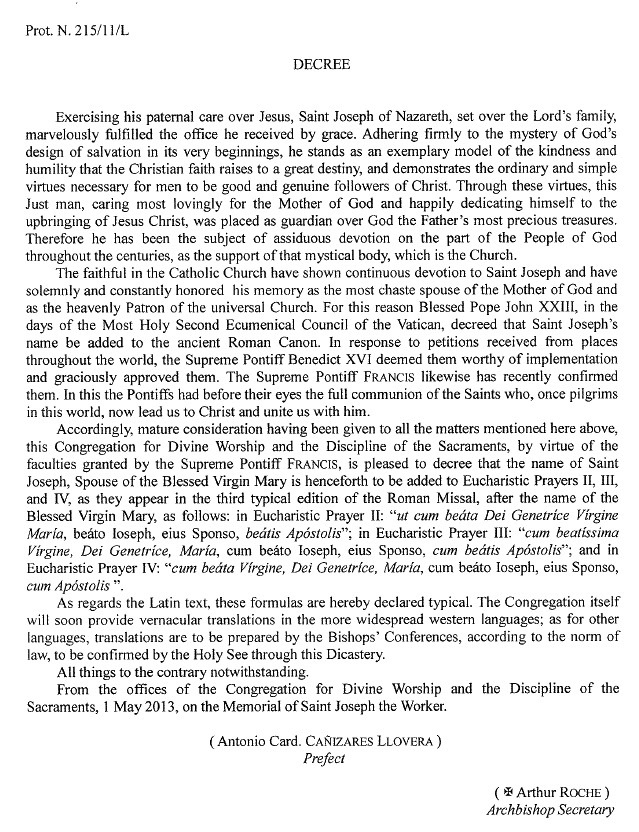
5/1/2013: Paternas vices by the Congregation for Divine Worship
Decree: On Adding the Name of St. Joseph to Eucharistic Prayers II, III, and IV

Holy Orders

?/?/1074: Decree on Simony and Celibacy by Council of Rome

11/30/1947: Sacramentum Ordinis by Ven. Pope Pius XII
Apostolic Constitution: On the Sacrament of Order


2/2/1961: Religiosorum Institutio by the Sacred Congregation for Religious
Instruction: On the Careful Selection and Training of Candidates for the States of Perfection and Sacred Orders


6/18/1967: Sacrum Diaconatus Ordinem by Pope Paul VI
Motu Proprio: General Norms for Restoring the Permanent Diaconate in the Latin Church

6/24/1967: Sacerdotalis Caelibatus by Pope Paul VI
Encyclical: On the Celibacy of the Priest


6/18/1968: Pontificalis Romani Recognitio by Pope Paul VI
Apostolic Constitution: Approving New Rites of Ordination of Deacons, Priests, and Bishops

8/15/1972: Ministeria Quaedam by Pope Paul VI
Motu Proprio: On First Tonsure, Minor Orders, and the Subdiaconate

10/15/1976: Inter Insigniores by the Sacred Congregation for the Doctrine of the Faith
Declaration: On the Question of Admission of Women to the Ministerial Priesthood

5/22/1994: Ordinatio Sacerdotalis by Pope Bl. John Paul II
Apostolic Letter: On Reserving Priestly Ordination to Men Alone

2/22/1998: Directorium Pro Ministerio et Vita Diaconorum Permanentium by the Conregation for the Clergy
Directory: For the Ministry and Life of Permanent Deacons


11/4/2005: Instruction Concerning the Criteria for the Discernment of Vocations with Regard to Persons of Homosexual Tendencies in View of Their Admission to the Seminary and to Holy Orders by the Congregation for Catholic Education

6/28/2008: Guidelines for the Use of Psychology in the Admission and Formation of Candidates for the Priesthood by the Congregation for Catholic Education

Marriage/Matrimony

5/27/1832: Summo Iugiter Studio by Pope Gregory XVI
Encyclical: On Mixed Marriages

2/10/1880: Arcanum by Pope Leo XIII
Encyclical: On Christian Marriage

12/24/1902: Dum multa by Pope Leo XIII
Encyclical: On Marriage Legislation

8/10/1907: Ne Temere by the Sacred Congregation of the Council
Decree: Concerning Betrothal and Marriage

12/31/1930: Casti Connubii by Pope Pius XI
Encyclical: On Christian Marriage

10/1/1970: Matrimonia Mixta by Pope Paul VI
Motu Proprio: On Mixed Marriages

3/28/1971: Causas Matrimoniales by Pope Paul VI
Motu Proprio: Determining Norms for Expediting Marriage Cases


9/4/1994: Annus Internationalis Familiae by the Congregation for the Doctrine of the Faith
Letter: Concerning the Reception of Holy Communion by the Divorced and Remarried Members of the Faithful


4/30/2001: Norms on the Preparation of the Process for the Dissolution of the Marriage Bond in Favour of the Faith by the Congregation for the Doctrine of the Faith


6/3/2003: Considerations Regarding Proposals to Give Legal Recognition to Unions Between Homosexual Persons by the Congregation for the Doctrine of the Faith