Showing posts with label John Saba (John of Dalyatha) (John the Venerable). Show all posts

Wednesday, June 11, 2014

The Manifold Perfections of Divinity

https://www.poeticous.com/frayluis 

"The divinity is jointly a sole perfection, and many perfections diverse, one in simplicity, and many in valor and eminence."--Fray Luis de León, The Perfect Wife §I

"Hear, O Israel, the Lord is our God, the Lord is one!"  So declares the Shema of Deuteronomy, and so declares the Church: and yet we also declare that God is Three.  Not only does the Divinity have three Persons, but God manifests Himself to us in a multitude of ways.  These three Persons show themselves to us in many, many ways.  (They are not themselves merely manifestations of the Divinity, for this was the ancient heresy of Modalism.)  One tradition speaks of the different "books" by which one encounters God: first is the book of Scripture, of course, but there is also the book of nature, and the book of experience, among others.  We learn of God through prayer, through the liturgy, through contemplation, through study.  Yet it is always the one God we learn of, the One Who Is, the One above being, above all that we can know of Him, even beyond our conception of God: as Dionysius said, He is "hyper-God" (ὑπέρθεος).

Monday, April 7, 2014

Continual Fire

http://people.ysu.edu/~ssmith/ecbyzwebpage/Christian%20Art%20Before%20the%20Peace.html
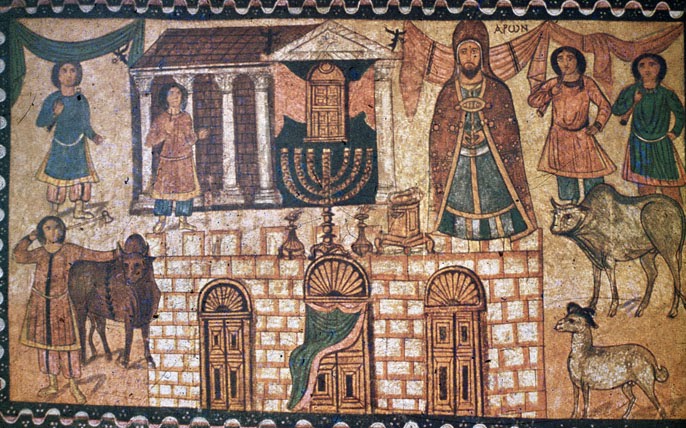
Aaron and the Tabernacle, from the Synagogue at Dura-Europos, Syria (c. 245-256)

"And fire through all will be kindled upon the altar, it will not be quenched."--Lev 6:6 (LXX)

Among the many regulations the Lord gave to His servants the Israelites, and particularly to the priestly Levites, we can see two key meanings, among others: a meaning for them in their literal worship in the Temple, and a meaning for us in our interior worship in the temple of our hearts.  When Leviticus thus speaks of the fire upon the altar, to draw forth spiritual meaning from the text, we should interpret the altar as the one within our hearts.  Just as the Levites were called to offer burnt offerings upon the physical altar, so are we called to immolate our wills for the Lord.  We are to destroy our souls to save them, to sacrifice all we have for He Who saves us.

Friday, March 2, 2012

"Accept My Bitter Tears": A Lenten Prayer by John Saba

John Saba (690-780), also known as John of Dalyatha or John the Venerable, was a Syrian monk from the region of Dalyatha, where modern-day Turkey, Iran, and Iraq meet.  His writings were well-read throughout the Christian East, and they are still popular today, at least in the Oriental Orthodox churches (where he is a saint), despite his being condemned as a Nestorian, a Messalian, and a Sabellian at different times.  Among his writings is the following prayer which fits perfectly for this holy season of Lent:


You who wept and shed tears of sorrow over Lazarus, accept my bitter tears. 

May my passions be allayed by Your Passion; may my wounds be healed by Your wounds, my blood be blended with Your blood, and the lifegiving fragrance of Your holy body be mingled with my body. 

May the bitter drink that was given to You by Your enemies soothe my soul, which has been made to drink wormwood by the evil one. 

May Your body, which was stretched out on the tree, stretch my mind out to you, for it has been shrunken by demons. 

May Your head which was bowed down upon the cross lift up my head, which has been buffeted by impure men. 

May Your pure hands, which were transfixed with nails by unbelievers, draw me up to you from the abyss of evil, as Your mouth has promised. 

May Your face, which has received spit of derision from accursed men, cleanse my face, which has become odious through its sins. 

May Your soul, which on the cross you committed to Your Father bring me up to You by Your grace.


As this first full week of Lent draws to a close, let us recommit ourselves to repentance and asceticism, and let us continue to especially remember the Passion of Our Lord Jesus Christ.  

Since I am not certain of John Sabas' veneration in the Eastern Catholic churches, let us ask for the prayers of another famous spiritual writer from Syria:

St. Ephrem the Syrian, pray for us!


Nota Bene: This prayer is from John's "Discourse on Flight From the World," and it is Excerpt LXVI in Brian E. Colless' The Wisdom of the Pearlers: An Anthology of Syriac Christian Mysticism.  Information on John was taken from Lucas Cleophas and OrthodoxChristianity.net.
 

Text ©2012 Brandon P. Otto.  Licensed via CC BY-NC.  Feel free to redistribute non-commercially, as long as credit is given to the author.