Showing posts with label icons. Show all posts

Monday, June 25, 2012

Iconic Icon Supplements: The Symbols of Icons

http://carmelite-monastery-gift-shop.mybigcommerce.com/our-lady-of-mount-carmel-gold/
 Icon of Our Lady of Mount Carmel (Mother of Carmel) by the Sisters of Our Lady of Mount Carmel, Terre Haute, IN

One of the biggest difficulties Western Christians have in appreciating icons is a lack of understanding.  I have previously discussed some of the theology behind iconography, but in this post I will discuss another big difficulty: the symbolism of iconography.  Even if one can understand the theology of the icon and why one should venerate it, it is still difficult to venerate something that seems to be such a strange mess of non-understood symbols.  This post will hopefully clear up some of that difficulty so that others can better understand icons and venerate them more worthily.

Friday, June 15, 2012

Our Holy and God-Bearing Fathers: St. John of Damascus


 St. John of Damascus (676-749), also known as St. John Damascene or Chrysorrhoas ("streaming with gold"), served as Chief Councilor (Protosymbullus) of Damascus under Muslim rule before later retiring to live the monastic life in the Monastery of St. Sabbas near Jerusalem.  He was a prolific writer whose work was incredibly influential, even to this day.  A particularly important note about his work was his exposition of the theology underlying icons: his work was thus key to the Seventh Ecumenical Council, Nicea II (787).  The Eastern Church often refers to him as "the last of the Fathers," and he is a Doctor of the Church often referred to as the Doctor of the Assumption.  His feast day in both the Western and Eastern Churches is December 4, though from 1890-1969 it was celebrated on March 27 in the Western Church.

St. John was brought up under Muslim rule in Damascus, where his strong Christian family held high hereditary public office under the caliphs.  When he reached the age of 23, his father found a Sicilian monk named Cosmas among prisoners of war, and this monk became the Christian tutor of St. John and his foster-brother, St. Cosmas the Hymnographer.  St. John eventually gained a post as protosymbullus of Damascus due to the high political status of his father.


In 726, the Byzantine emperor at the time, Emperor Leo the Isaurian, released an iconoclastic edict, which made St. John furious.  The saint at that time wrote his first work, Three Apologies Against Those Who Attack the Divine Images.  The iconoclastic emperor was not pleased, so, upon finding a manuscript written by St. John, Leo forged a letter in which St. John was supposedly offering to betray the city of Damascus into the Emperor's hands.  The caliph who ruled Damascus did not accept St. John's pleas of innocence, and he punished the saint by cutting off his right hand.

To the utter shock of the caliph, St. John's hand did not stay detached: after praying before an icon of the Virgin Mary, the saint's hand was miraculously reattached.  In order to thank the Theotokos for this miracle worked through her intercession, St. John created a silver cast of his hand and attached it to the icon, thus giving the icon the name Trojeručica, or the Three-Handed Theotokos.

St. John of Damascus entreating the icon of the Theotokos for healing

Following this miracle, the caliph apologized for his false accusations, and he offered St. John his same public office.  The saint declined, though, instead retiring to the Monastery of St. Sabbas near Jerusalem, where he spent the rest of his life in fervent prayer and copious writing until his death in 749.  Shortly after his death, he was revered as a saint, and in 1883 the Holy See named him a Doctor of the Church, placing him on the universal Church calendar in 1890.

As mentioned above, St. John was a copious writer.  His first work, Three Apologies Against Those Who Attack the Divine Images, is most likely the most important work on the theology of icons, and it was highly influential for the Second Council of Nicea.  A discussion of some of his arguments, along with those of St. Theodore the Studite, can be found in an earlier post of mine.  Below is a fantastic quote on our "salvation through matter" from the first Apology:

"I do not worship matter; I worship the Creator of matter Who became matter for my sake, Who willed to take His abode in matter; Who worked out my salvation through matter.  Never will I cease honoring the matter which wrought my salvation!  I honor it, but not as God...God's Body is God because It is joined to His Person by a union which shall never pass away" (1.16).

 Another major work of St. John's was The Fountain of Wisdom (Fountain of Knowledge), a work divided into three parts: Philosophical Chapters, Concerning Heresy (which includes one of the first Christian polemic writings against Islam, and the first from a member of the Byzantine Church), and An Exact Exposition of the Orthodox Faith (De fide orthodoxa) (the first work of Scholasticism in the Eastern Church).  The last section of this work, a summary of the dogmatic writings of the Fathers, is quoted and referenced frequently by St. Thomas Aquinas in his Summa Theologica.


Besides those two greatest works of his, St. John wrote many shorter works, including An Introduction to Elementary Dogmatics, On the Two Wills of Christ (written against the Monothelites), and, a work with a fascinating title, On Dragons and Ghosts.  St. John also penned the Octoechos (Οκτοηχος), the liturgical book containing the weekly variable texts in the eight tones of Byzantine Psalmody.  (St. John is considered to be the one who systematized the eight-tone system of Byzantine liturgical music.)  Among multiple canons that he wrote is a popular Paschal canon, including such wonderful prayers as these:

"Let the God-inspired Habakkuk the Prophet stand with us on the holy watch-tower.  Let him point out to the radiant Angel who proclaims with vibrant voice: 'Today, Salvation comes to the world, for Christ is risen as All-powerful!'" (Fourth Ode)

"We celebrate the very death of Death and the overthrow of Hell, and the beginning of another life, which is eternal.  Let us sing in joy to the Author of these marvels: the only blessed and most glorious God of our Fathers!" (Seventh Ode)

"Shine, shine, O New Jerusalem, for the glory of the Lord has shone upon you.  Rejoice and be glad, O Sion, and You, O Pure One, O Mother of God, exult in the Resurrection of Your Son!" (Ninth Ode)


St. John wrote many other popular prayers, used in daily prayers and preparation for receiving the Sacred Mysteries, among other purposes.  What may be one of his most popular prayers (as a hint at its popularity, the first line is quoted in Leo Tolstoy's War and Peace) is a prayer recited just before heading to bed:

"O Lord, Lover of mankind, is this bed to be my coffin, or will You enlighten my wretched soul with another day?  Here the coffin lies before me, and here death confronts me.  I fear, O Lord, Your Judgment and the endless torments; yet I cease not to do evil.  My Lord and God, I continually anger You, and Your Immaculate Mother, and all the Heavenly Powers, and my Holy Guardian Angel.  I know, O Lord, that I am unworthy of Your love, but deserve condemnation and every torment.  But, whether I want it or not, save me, O Lord.  For to save a good man is no great thing, and to have mercy on the pure is nothing wonderful, for they are worthy of Your mercy.  But show the wonder of Your mercy to me, a sinner.  In this, reveal Your love for man, lest my wickedness prevail over Your unutterable goodness and mercy.  And order my life as You will."

To end this post, let us remember with gladness our holy and God-bearing Father, St. John of Damascus, for he defended the holy images, taught us to chant joyful hymns to the Lord in sacred music, expounded the true faith, and gave us many prayers.

"Champion of Orthodoxy, teacher of purity and true worship,
the enlightener of the universe and the adornment of hierarchs:
all-wise father John, your teachings have gleamed with light upon all things.
Intercede before Christ God to save our souls."
(Troparion of the Feast Day of St. John of Damascus, Tone 8)

St. John of Damascus, our holy and God-bearing Father, pray for us!


Nota Bene: Sources of information for this post included OrthodoxWiki (John of Damascus, Cosmas the Hymnographer, Octoechos) and Wikipedia (John of Damascus, Second Council of Nicea).  The quote from the Apologies comes from the translation in On the Divine Images in the St. Vladimir's Seminary Press' Popular Patristic Series.  Quotes from the Paschal Canon of St. John of Damascus come from the Publican's Prayer Book by the Melkite Catholic Eparchy of Newton, pp. 297, 302, and 304, respectively; the prayer before bed comes from p. 68 of the same book.  The Troparion of St. John's feast day comes from his above-cited OrthodoxWiki article. 
 

Text ©2012 Brandon P. Otto.  Licensed via CC BY-NC.  Feel free to redistribute non-commercially, as long as credit is given to the author.


Sunday, June 3, 2012

Iconic Icons Supplement: Icons of the Trinity

In celebration of Trinity Sunday in the Western Church today, I decided to write a short post on the history of artistic representation of the Most Holy Trinity, especially in the East.

Nowadays, there are many representations of the Trinity showing the Three Persons as an old man (the Father), Jesus Christ, and a dove (the Holy Spirit).  Before these were in vogue, the Trinity was often depicted symbolically (especially in the Western Church) in forms such as a triangle-encased All-Seeing Eye (a symbol adapted and Christianized from ancient Egyptian symbolism that is, sadly, now usually connected with Freemasonry).  In the earliest days of the Church, though, there were no representations of the Trinity apart from the Second Person Incarnate.

http://catholicmom.com/2013/10/12/man-on-a-mission-mission-san-miguel-archangel/
Eye of God, Mission San Miguel, California (19th century)

Sunday, May 20, 2012

Iconic Icons: The Ascension

 Ascension Icon by Andrei Rublev (late 14th - early 15th century).

The Ascension of Our Lord Jesus Christ is traditionally celebrated, following the detail of Acts 1:3, on the Thursday 40 days after Pascha (Easter), which was last Thursday, though most Latin Rite dioceses (at least in the U.S., if not in other countries as well) transfer the celebration of this feast to the next Sunday, which is today.  In Greek, this feast is called 'Η Αναληψις: analepsis means a "taking up," although the term is used in narrative analysis (of films, novels, and other works) to indicate a flashback. 

The events of this feast are outlined in Mark, Luke, and Acts:

"So then the Lord Jesus, after He had spoken to them, was taken up into Heaven, and sat down at the right hand of God" (Mk 16:19).

"Then He led them out as far as Bethany, and lifting up His hands He blessed them.  While He blessed them, He parted from them, and was carried up into Heaven" (Lk 24:50-51).

"And when He had said this, as they were looking on, He was lifted up, and a cloud took Him out of their sight" (Acts 1:9).

 The Ascension of Our Lord by the Novgorod School, in the Malo-Kirillov Monastery (1543).

The festal icon incorporates some of the details of these accounts, but it is more meant to be a representation of the Church than the event per se.  The main figure is, of course, Our Lord Jesus Christ in a mandorla (though it is usually more round than almond-shaped) flanked by angels, giving a blessing with His right hand (as Luke relates) and holding a scroll in His left hand.  Though the icon is of the Ascension, there is no directional movement explicitly depicted, so it could also represent His Second Coming (since, as angels told the apostles, "This Jesus, Who was taken up from you into Heaven, will come in the same way as you saw Him go into Heaven" (Acts 1:11)). 

Below the Lord is the Theotokos, Mary the Mother of God, flanked by angels and surrounded by disciples.  The icon is not strictly historical, thus Mary is present, as is St. Paul--usually found just to the right of the Blessed Mother--who had not been converted yet.  While the disciples are in confusion at this event, the Theotokos is calm and in a posture of prayer.  She is in the center of the icon, below Jesus.  Mary together with the disciples represent the entire Church as she celebrates the Lord's Ascension and awaits His Second Coming.  The angels in white garments both represent the angels who appeared to the disciples after the Ascension (vid. Acts 1:10-11) and the angels who constantly guard the Church at the Lord's command.

 Ascension Icon by a Coptic Christian artist (14th century).

The Ascension by Christo Dimitrov of the Samokov School, 
in the Church of Ss. Cyril and Methodius in Gabrovnitsa, Pazardjik, Bulgaria (19th century).

"May Almighty God bless you,
for on this very day His Only-Begotten Son
pierced the heights of Heaven
and unlocked for you the way
to ascend to where He is.
Amen."
--Roman Missal, Solemn Blessing 7: The Ascension of the Lord

 The Ascension of Christ by Pietro Perugino (late 1490s).
[Though not a traditional icon, it follows the same general structure.]

 The Ascension by Theophanes the Cretan, in Stavronikita Monastery on Mount Athos (1546).

"After fulfilling for us Your Plan of Redemption
and joining the things of earth with those of Heaven,
You gloriously ascended, O Christ our God,
without abandoning us, but remained with us forever
and proclaimed to those who love You:
'Behold, I am with you;
no one has power against you.'"
--Kontakion of the Ascension of our Lord, God and Savior Jesus Christ (6th Tone)

Ascension icon on Folio 13v of a Syriac Gospel book by the Scribe Rabbula
 from the Monastery of St. John of Zagba (586).
[Information found here.]
 
 Ascension icon from Sinai (9th century).

O All-Blameless Theotokos, pray for us to your Son, Our Lord Jesus Christ, the Ascended One!


Nota Bene: Biblical quotations are all from the RSV-CE published by Ignatius Press.  Quotation from the Roman Missal was found at CNP Liturgical Planning.  The Kontakion was found in the Publican's Prayer Book published by the Melkite Catholic Eparchy of Newton.  Other sources of information for this post were OrthodoxWiki, the Greek Orthodox Archdiocese of America, and Answers.com.
 

Text ©2012 Brandon P. Otto.  Licensed via CC BY-NC.  Feel free to redistribute non-commercially, as long as credit is given to the author.


Sunday, April 22, 2012

The Rosary and the Komboskini


Each Wednesday during the school year, I pray a Rosary with a spiritual brotherhood I am a member of, a Rosary that is often prayed during a procession led by an icon of Our Lady of Czestochowa.  This past week, as I prayed with my rosary in my right hand and my komboskini around my left wrist, I thought of the sublime combination of traditions.

On one hand, we were praying the Rosary, the traditional Marian prayer revealed to St. Dominic.  With this prayer, we fervently beseeched the intercession of Our Lady, the Mother of God, as we meditated upon the mysteries of the life of Our Lord.  On the other hand (quite literally), my komboskini wrapped around my wrist reminded me to constantly remember Jesus Christ and to pray unceasingly the Jesus Prayer: Lord Jesus Christ, Son of God, have mercy on me, a sinner.  The Rosary is a traditional devotion of the Western Church, and the Jesus Prayer prayed on a komboskini is a traditional devotion of the Eastern Church.  To lead these prayers, an icon from Poland was processed, and, as my girlfriend's father remarked, Poland can be seen as a geographical point of connection between the Western and Eastern Churches (he mentioned this in connection to the devotion to Divine Mercy of St. Faustina Kowalska, which he sees as being a great tool for the reuniting of the two lungs of the Church).

Thus, in this one time of prayer, traditions from both lungs of the Church were used to lead me deeper into prayer.  I see a brilliant complementarity between the rosary in one hand and the komboskini in the other: with the one, we ask the intercession of the Theotokos as we meditate on the mysteries of the life of Our Lord, and, with the other, we unceasingly keep the name of Jesus Christ in our hearts, minds, and souls, as we continually ask Him for mercy.  With the one we beseech the Mother, and with the other we beseech the Son.  The use of komboskini also helps me see the Christocentrism present in the Rosary, for I often have a difficulty with Marian prayers being too about Mary with little connection to the Lord.  With the komboskini unceasingly reminding me of Jesus Christ, though, I am able to pray the Rosary with greater fervor and devotion.

This personal example just shows one more way how the use of both lungs of the Church can lead us deeper into devotion to the Triune God, Father, Son, and Holy Spirit.  Praise the Lord for His great gift of the two lungs of the Church!

St. Dominic, pray for us!

Text ©2012 Brandon P. Otto.  Licensed via CC BY-NC.  Feel free to redistribute non-commercially, as long as credit is given to the author.

Sunday, April 8, 2012

Iconic Icons: 'Η Αναστασις (The Resurrection)

Anastasis icon dated 1315 from the Church of the Holy Saviour in Chora in Istanbul, Turkey
  Χριστος ανεστι!  Christ is risen!  (And you, of course, are responding, "Αλειθος ανεστι!  Truly He is risen!")  Today (for those following the calendar of the Catholic Church) is Pascha (Easter, for most English speakers), the most holy day of days, the feast of feasts, the day of the Resurrection of Our Lord Jesus Christ.  Today is the true Passover, when Christ passed over from death to life, and because of this it truly bears the name Pascha ("Passover" in Greek).  To celebrate this miracle of miracles, the Eastern Church has a festal icon of Christ's Resurrection, just as they have icons for various other feasts.

The icon of Pascha is 'Η Αναστασις, The Resurrection.  (Etymologically, anastasis literally means "standing again," combining ana (again) and stasis (standing).)  Though there are multiple Paschal icons, this is the most prominent, showing what is known in the West as the "Harrowing of Hell" (the technical name of this icon is "Christ's Descent Into Hades").  It represents the line of the Creed that states "He descended into hell," where He rescued the just who came before Him.  (An interesting side note: there are two Greek words often viewed as interchangeable by English speakers: Hades and Gehenna.  Both are commonly held to mean "Hell."  Truly, though, Hades is similar to the Jewish notion of Sheol, a place of the dead with neither pleasure nor pain, more of a resting place before judgment.  Gehenna, on the other hand, is what we usually mean by "Hell": the state of eternal punishment for those who reject Christ.) 


The icon shows Christ lifting Adam and Eve from their graves and bringing them into everlasting life.  Behind Him on the left often stand many patriarchs and prophets, among them John the Forerunner (St. John the Baptist), David, Solomon, Moses, and Abel, and on the right stand contemporaries of Christ.  Beneath Christ's feet are the gates of Hades, crushed by His divine power, and strewn about are the remnants of the locks and keys that kept them closed (these details actually seem to reflect the apocryphal Gospel of Nicodemus).  Christ Himself bears the marks of His Passion, the marks of the nails in His hands and feet, and around Him is a mandorla, a special iconographic type of nimbus/halo that signifies the glorified body of Christ.  The mandorla is also seen in other icons, such as the Transfiguration and the Ascension; it is usually blue or white and almond-shaped (the word mandorla means "almond" in Italian).  Sometimes the icon also contains Satan or other evil spirits being trampled by Christ or being restrained by angels.

In summary, the Anastasis shows Christ's power over Hades through His Resurrection and how God did not leave those faithful to Him in the past to be left there forever: He even rescued those who first sinned against Him.  Let us praise God for His great mercy in the Resurrection!

Christ is risen from the dead, trampling down death by death, and upon those in the tombs bestowing life.

Lord Jesus Christ, risen from the dead, have mercy on us!


Nota Bene: Information for this post comes from OrthodoxWiki (Resurrection, Mandorla), Mennonite Life, and Image and Likeness Iconography.
 

Text ©2012 Brandon P. Otto.  Licensed via CC BY-NC.  Feel free to redistribute non-commercially, as long as credit is given to the author.


Thursday, February 2, 2012

Iconic Icons Supplement: Ethiopian Icons

Like almost any product of man, icons contain differences depending on the culture in which they were made (besides even more differences from individual artists).  Thus among icons, there are different styles relating to the different cultures of origin: Greek (Byzantine), Russian, Coptic, Ethiopian, etc.  Usually in my posts, I include and discuss Byzantine icons, though Russian icons are also involved often.  In this post, I wish to give a brief overview of another style of icons: Ethiopian iconography.

The Ethiopian Orthodox Church began when Christianity was first widely spread to Ethiopia (discounting the Ethiopian eunuch converted by St. Philip in Acts 8) in the 5th century by a group of missionaries known now as the Nine Saints: Abba Aftse, Abba Alef, Abba Aragawi, Abba Garima (Isaac/Yeshaq), Abba Guba, Abba Liqanos, Abba Pantelewon, Abba Sehma, and Abba Yem'ata.  It is conjectured that they were possibly refugees from persecutions after the Council of Chalcedon: this Council declared the two natures of Christ, human and divine, and these missionaries (like the Ethiopian Orthodox Church to this day) were Miaphysite (believers in "One United Nature": often this is confused with Monophysite, "One Single Nature," which is a term not used by this Church itself).  (Just as a side note, this Miaphysitism, or Non-Chalcedonianism, is common to all Oriental Orthodox Churches: Coptic Orthodox, Ethiopian Orthodox, Eritrean Orthodox, Syriac Orthodox, Malankara Orthodox Syrian (in India), and Armenian Apostolic churches.)  Christians who did not accept the definition of the Council of Chalcedon, such as the Nine Saints, were persecuted, so it is thought that they escaped to Ethiopia to free persecution.  In addition to spreading Christianity in Ethiopia, some of the Saints also founded monasteries following the rule of St. Pachomius.  Besides this origin and differing Christology (Miaphysitism), the Ethiopian Orthodox Church is well known for reportedly having possession of the original Ark of the Covenant built according to the commands of God given through Moses, as recorded in the Pentateuch: this Ark would contain the (second set of) tablets containing the Ten Commandments, as well as possibly other items from the time of Moses (such as manna and Aaron's staff).

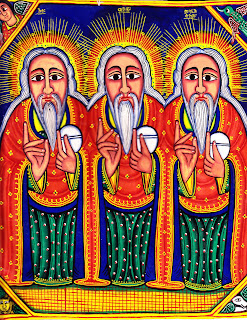
Ethiopian iconography is characterized by their palette of colors (brighter colors than Byzantine iconography, and usually more colors as well), an art style that seems more rounded and less defined (one could say it looks more similar to animation than portraits, which Byzantine iconography is more similar to), the lack of a gold (or other solid, distinct color) background in general, the frequent lack of text, and painted, rather than gilded, halos (if they are present at all, which sometimes they are not).  Some differing iconographic conventions compared to Byzantine iconography are depictions of the Holy Trinity (which was for a long time not allowed at all in Byzantine iconography and is still often discouraged) in the form of three identical white-haired men, seated in a row, and a change in color symbolism, such as Mary's outer garment being deep blue rather than red.  Among the more favored subjects of Ethiopian iconography are the Flight from Egypt (as a reminder that Africa sheltered the Holy Family); St. George, the patron of Ethiopia, who is often seen close to Mary; Mary and the Christ Child flanked by angels; St. Michael the Archangel; the Nine Saints mentioned above, who are often depicted in a circle; various events from the lives of Mary and Jesus; and Ethiopian saints, especially Takla Haymanot from the 13th century (renowned for praying so long standing on one leg that his other leg fell off and for miraculously receiving six wings to prevent a fatal fall when a rope broke as he climbed down a mountain).

Below is a small gallery of images of Ethiopian icons:

The Trinity

The Flight from Egypt

The Flight from Egypt

St. George (though the source claims it to be St. Michael)

St. Michael

The Nine Saints

Takla Haymanot


I hope this introduction to the iconography of Ethiopia was interesting and helpful.  To conclude, I'd like to ask for the intercession of a Roman Catholic Ethiopian: Bl. Ghebre Michael (1788-1855).  Bl. Ghebre was a one-eyed Ethiopian Orthodox monk who eventually converted to Catholicism due to his friendship with St. Justin de Jacobis, a Vincentian missionary from Italy.  After converting, being ordained a priest, and deciding to become a Vincentian, Bl. Ghebre, along with other Catholics, were arrested and tortured for not professing the Miaphysite Christology of the Ethiopian Orthodox Church.  Due to the intervention of the British, Bl. Ghebre was not executed for apostasy, but he was forced to follow the army while in chains.  This harsh treatment eventually lead to his death, and he was beatified as a martyr in 1926.  (As an interesting fact, the picture of Bl. Ghebre below may be a drawing of him by St. Justin himself.)

Thank you for reading, and God Bless.

Bl. Ghebre Michael, pray for us!


Nota Bene: Information for this post comes from Wikipedia (Nine Saints, Ethiopian Orthodox Church, Oriental Orthodoxy), Orthodox Wiki (Takla Haymanot), the Smithsonian's National Museum of African Art, Betsy Porter, FamVin (Ghebre Michael, Justin de Jacobis) and Adigrat Eparchy.
 

Text ©2012 Brandon P. Otto.  Licensed via CC BY-NC.  Feel free to redistribute non-commercially, as long as credit is given to the author.


Thursday, January 26, 2012

Iconic Icons Supplement: Our Lady of Guadalupe


"Am I not here, I, who am your mother?"

I must apologize for taking so long to write about Our Lady of Guadalupe (Nuestra Señora de Guadalupe): though her image is not an icon in the typical sense (that is, made by human hands for the purpose of connection to Christ or the saints in Heaven), it most definitely should be classified as an acheiropoieton (an sacred image not made with human hands).  I apologize for not including it in my original post on these images: it didn't enter my mind until much later.  This post, then, is a supplement for my post on the acheiropoieta.

St. Juan Diego (1474-1578) was a Native American from what is now Mexico (his birth name was Aztec: Cuauhtlatoatzin).  Originally a mystical and devout pagan, around 1520 or so he converted to Christianity, taking the name Juan Diego.  Shortly thereafter, in 1529, he became a widower, yet his faith remained strong.  It was in 1531 that the events for which he is now known began.

On Saturday, December 9, 1531, Juan Diego was running down Tepeyac Hill (near Mexico City) to attend Mass, when suddenly the Blessed Virgin Mary appeared to him.  She told Juan Diego to have the bishop build a church on the place she stood.  The obedient saint ran to the bishop and told him these events.  The bishop, understandably wary, examined the farmer (for that was Juan Diego's profession) carefully, and then directed him to ask the Virgin for a sign that she was truly the Mother of God.

The following Tuesday, December 12, the saint was running to get medicine for his dying uncle, and he changed his course to avoid Tepeyac, where the Virgin said she would appear again.  Undeterred, Mary appeared in his path and asked, "What road is this thou takest, son?"  She entered into a maternal dialogue with Juan Diego, reassuring him about his uncle (also appearing to said uncle and curing him) and calling herself "Holy Mary of Guadalupe."  When she told the saint to return to the bishop, he asked for the requested sign.  She instructed him to go to some nearby rocks and gather roses.  Knowing this was neither the proper season for roses nor a place roses would grow, Juan Diego still obeyed the Virgin's command, and, to his surprise, roses abounded among the rocks.  He gathered them into his tilma (a long cloak worn by his people) and returned to the Virgin.  She arranged the roses and asked him to keep them hidden and untouched in his tilma until he reached the bishop.  Keeping the orders of Mary, Juan Diego walked to the bishop's and unfurled his cloak, dropping roses as fresh and dewy as if they had just been picked on a spring morning.  Looking at the bishop and his attendants to see their response, he saw them kneeling before him.  In confusion, he looked down at his tilma.

On the tilma was a life-size image of the Blessed Virgin, exactly as she appeared to Juan Diego.  She appeared in the clothes of a Native American woman of that region (that is, clothes based in Aztec culture), with a sash on her waist and a star-filled cloak on her shoulders.  Unlike most images, the Virgin was most noticeably pregnant, pregnant with the Son of God.  Her eyes were closed, her hands folded in prayer, and her feet on a crescent moon (a symbol of an Aztec god that she was crushing).  Beneath the moon was an angel, shown in an Aztec style (for instance, the wings were colored in blue, yellow, and red), holding up the Virgin's robes.  All around, Mary shone with radiant light, Heaven's light, the light of her Son.

The bishop enshrined the tilma with the Virgin's miraculous image in the preliminary shrine he built according to Mary's wishes, and St. Juan Diego spent the rest of his days as a hermit, guarding this blessed image.  Since that time, the acheiropoieton (for that is truly what it is) has remained at Tepeyac Hill, moving from shrine to shrine as new ones were built.  Presently, it resides in a basilica built to house it in 1904.

Our Lady of Guadalupe is frequently invoked in the Americas.  Indeed, her titles include "Patroness of the Americas" (I've also seen "Empress" often), "Empress of Latin America," and "Protectoress of the Unborn."  She is the patron of the Americas, especially Mexico, and Native Americans especially venerate her.  Due to her pregnancy in the image, she is often invoked among those in the pro-life apostolate.  Her feast day is December 12, while St. Juan Diego's feast day is December 9.

Before I close, I just want to write a short digression on the Virgin's title: "of Guadalupe."  There was no place named Guadalupe where she appeared: indeed, she appeared on Tepeyac Hill.  Why is she not then called "Our Lady of Tepeyac"?  That is due to her own command.  Why did she pick this name, then?  One theory is that she spoke a term in Nahuatl (the language of the Aztecs, the native language of Mexico).  Some alternatives are Tequatlanopeuh ("she whose origins were in the rocky summit"), Tequantlaxopeuh ("she who banishes those who devoured us"), or Coatlaxopeuh ("the one who crushes the serpent"--possibly referring to Quetzacoatl, a popular Aztec serpent god).  Another theory I've heard (which I think I am most inclined to) is that the name is a reference to the city of Guadalupe in Spain.  In this city there was a miraculous statue of Our Lady carved by St. Luke the Evangelist given to the St. Leander, Bishop of Seville, by Pope St. Gregory the Great.  After this statue was lost for 600 years, it was rediscovered in 1326 by Gil Cordero, who was led to it by a vision of the Blessed Mother.  This statue was even referred to as Our Lady of Guadalupe due to its being rediscovered there.  There will probably never be a definite answer, as debate seems to be too common, but the one thing certain is this: the Blessed Virgin declared she wished to be known as Our Lady of Guadalupe, so how can we refuse her wish?

The statue entitled Our Lady of Guadalupe in Spain

Again, I apologize for not discussing Our Lady of Guadalupe with the rest of the acheiropoieta, but it honestly slipped my mind.  I also find her patronage as Protectoress of the Unborn timely to remember due to the recent March for Life in Washington, D.C. and due to the recent mandate by the U.S. government that all health care plans will have to provide not only contraceptives, but abortifacients (drugs that cause an abortion chemically rather than surgically).  Keeping this patronage in mind, let us ask for the prayers of the Theotokos under her title as Our Lady of Guadalupe, and let us ask for the prayers of her faithful servant, Juan Diego.

Our Lady of Guadalupe, Protectoress of the Unborn, save us!
St. Juan Diego, pray for us!

 
Nota Bene: Most of my information came from the Saints.SQPN.com pages on St. Juan Diego and Our Lady of Guadalupe.  Additional information came from Wikipedia and Our Lady of Guadalupe.
 

Text ©2012 Brandon P. Otto.  Licensed via CC BY-NC.  Feel free to redistribute non-commercially, as long as credit is given to the author.


Sunday, January 8, 2012

Iconic Icons: Axion Estin

The original icon

 The original icon without its riza (the metal covering revealing only the faces)

The Axion Estin (Αξιον εστιν), "It is truly meet," is an icon of the Theotokos (Eleusa-style) located in the the Protaton, a church in the Karyes settlement of the famous Mount Athos in Greece, home to many ancient monastic communities.  The event which the icon takes it name from occurred in 980, so the icon was written sometime before then.

The name of the icon comes from the opening words of a Marian hymn in the Divine Liturgy of St. John Chrysostom.  Up until this famous event, the hymn only included the latter half, starting at "More honourable than the Cherubim," which was written in the late 700s by St. Cosmas the Hymnographer, foster-brother of St. John Damascene.  This section of the hymn reads thus:

More honorable than the cherubim,
and beyond compare more glorious than the seraphim.
Without corruption thou gavest birth to God the Word.
True Theotokos, we magnify thee.

On June 11, 980, a passing monk who called himself Gabriel was granted hospitality in a cell near Karyes.  During a Saturday night vigil service (the service of Sunday Matins) being prayed before the icon, when the hymn of St. Cosmas was being recited, the passing monk began to chant a new section of a hymn before continuing on to the familiar hymn:

It is truly right to bless thee, O Theotokos, 
ever blessed, and most pure, and the Mother of our God.

The monk from Mount Athos was entranced by the beauty of this new section of the hymn, so he asked the passing monk to write it down: however, no paper or ink could be found.  Undeterred, the mysterious monk inscribed the lines on a stone tile with his finger, and he decreed that the hymn be recited with this addition ever after.  Following this, he disappeared, and with this disappearance, the icon began to radiate light for a while afterwards.

 An icon of the miraculous revelation of the hymn by St. Gabriel

After this event, the modified hymn was spread around all Christians of the East.  The icon was transferred to the Protaton, the main church of the settlement of Karyes, where it is located to this day.  The tile inscribed by the Archangel Gabriel (the traditionally-accepted identity of the passing monk) was taken to Constantinople as evidence of the miracle and in order that the hymn be dispersed throughout the world by St. Nicholas II Chrysoberges (the Patriarch of Constantinople from 984 to 996).

There is little discussion about the icon itself I can find: most sources just related (with varying details, of course) the story I have just related to you.  The most interesting thing about the icon is scroll that the Christ Child is handing to the Theotokos.  Though I cannot tell what the scroll represents, it seems to be an interesting foreshadowing of the miraculously-revealed text connected to the icon.


The revelation of the hymn by St. Gabriel (and thus the icon as well) is celebrated on June 11th, and the icon by itself is celebrated on July 13th.  For a bit more information (and a reflection) on the hymn itself, see this post from The Ever Blessed.  I hope this post was helpful.  Thank you for reading, and God Bless.

St. Cosmas the Hymnographer, pray for us!

  
Nota Bene: I compiled the story for this post from many sources: Iconograms, The Orthodox Christian Faith, OrthodoxWiki (on the Panagia Axion Estin and on St. Cosmas), Mount Athos, and Wikipedia (the translation of the hymn was taken from here).
 

Text ©2012 Brandon P. Otto.  Licensed via CC BY-NC.  Feel free to redistribute non-commercially, as long as credit is given to the author.


Tuesday, January 3, 2012

Iconic Icons: Theotokos of Vladimir

 
The original Vladimirskaya

The Theotokos of Vladimir (Our Lady of Vladimir, the Virgin of Vladimir), Владимирская (Vladimirskaya) in Russian, is an Eleusa style icon of the Theotokos.  According to Russian tradition, it was written by St. Luke the Evangelist on a board from the Holy Family's table: upon seeing it, the Virgin exclaimed, "Henceforth, all generations shall call Me blessed. The grace of both My Son and Me shall be with this icon."

The first historical mention of it is its sending by Greek Patriarch Luke Chrysoberges of Constantinople to Prince Mstislav (or Grand Duke Yury Dolgoruky) in 1131.  The icon was placed in a monastery near the city of Vyshgorod.  Andrei Bogoliubsky (son of Yury Dolgoruky and a saint among the Eastern Orthodox) built the Dormition Cathedral in Vladimir and installed the icon there in 1155.  (Tradition says the location of Vladimir was chosen because donkeys carrying the icon would not move past the town, and this was interpreted as a sign that the Virgin wished to remain in Vladimir.)

During the invasion of Tamerlane in 1395, the icon was moved from Vladimir to Moscow.  When the Great Prince Basil (Vasily) I went out to meet the icon as it was traveling to Moscow, he spent a night in prayer and weeping before it, and the same night Tamerlane had a vision of a radiant woman commanding him to turn back.  When he asked his experts the meaning of the vision, they said the woman was the Mother of God, Protectress of Christians.  Upon hearing this, Tamerlane ordered his troops to retreat.

After the fleeing of Tamerlane, the icon was placed in the Cathedral of the Dormition of the Moscow Kremlin, where the intercession of the Theotokos of Vladimir was credited with saving Moscow from Tartar hordes in 1451, 1480, and 1521.  Many centuries later, 1941, Joseph Stalin allegedly ordered that the icon be flown around Moscow as the Germans advanced toward it.  A few days later, the Germans retreated.

The icon, while in the Moscow Kremlin, also was present at many other important events in Russian history.  Some of these include the elevation and election of Jonah, Metropolitan of Moscow and All Russia, in 1448, Job, the first Patriarch of Moscow and All Russia, in 1589, and Tikhon, Patriarch of Moscow and All Russia and "Enlightener of North America," in 1917 (all three of these are saints among the Russian Orthodox).

There are three festal days of the Theotokos of Vladimir for the Russian Orthodox.  On August 26th is celebrated the Meeting of the Vladimir Icon upon its Transfer from Vladimir to Moscow, when Basil I prayed before the icon and the Virgin command Tamerlane to retreat.  On June 23rd is celebrated the Saving of Moscow from the Invasion of Khan Achmed, a leader of the Tartar horde that attacked Russia in 1480.  On May 21st is the Celebration of the Vladimir Icon of the Mother of God, which remembers her intercession that protected Russia from the Tartar invasion of 1521.

Due to its fame, many copies were made of the Vladimirskaya, some of which themselves became wonder-working.  The most famous is Our Lady of St. Theodore (Black Virgin Mary of Russia), or Федоровская (Fyodorovskaya) in Russian.  The St. Theodore of the title (Theodore is "Fyodor" in Russian, hence Fyodorovskaya) is St. Theodore Stratelates, a Greek martyr and warrior saint from the 4th century.  The icon was found in a forest on August 16, 1239, by Prince Vasily of Kostroma.  When he tried to touch it, it miraculously rose in the air.  He brought the icon back to his city, and it was venerated in the Assumption Cathedral there.  When the cathedral burned down, almost all the icons in it were destroyed, but the Fyodorovskaya was found intact three days after the fire.  A copy of the icon was given to Mikhail Romanov, the first tsar of the Romanov dynasty, by his mother Xenia upon his acceptance of the position of tsar.  Due to this, the Fyodorovskaya became the patron icon of the Romanov family, and its fame grew considerably.  Presently, the original Fyodorovskaya is in the Epiphany Cathedral of Kostroma, and Our Lady of St. Theodore has two feast days in the Russian Orthodox Church: March 27th and August 29th.

There are debates surrounding the history of the Fyodorovskaya and its name.  According to some, the icon was originally owned by the town of Gorodets-on-the-Volga but was lost after the Mongols sacked the town.  After hearing of the icon in Kostroma, the town of Gorodets demanded the icon back, and instead they were sent a copy of it.  There are two main traditions for the name.  The first is that an apparition of St. Theodore Stratelates carrying the icon into the forest was seen while Prince Vasily was there.  The second is that the icon was originally commissioned by Grand Prince Yaroslav II of Vladimir, whose Christian name was Fyodor.  Also, the main difference between the Vladimirskaya and the Fyodorovskaya in appearance is that in the latter, the Christ Child has a bare leg.  One source says this was possibly a detail of the original Vladimirskaya (which was repainted numerous times, hence the absence of this detail today).

 The original Fyodorovskaya

At the end of this post, as at the end of the last one, let us ask for the prayers of the Theotokos that the Russian Orthodox Church may be reunited with Rome.

Theotokos of Vladimir, save us!

A copy of the Vladimirskaya written by Andrei Rublev

Nota Bene: The main sources of information for this post were Wikipedia (on the Vladimirskaya and the Fyodorovskaya) and Orthodox Wiki.
 

Text ©2012 Brandon P. Otto.  Licensed via CC BY-NC.  Feel free to redistribute non-commercially, as long as credit is given to the author.


Monday, January 2, 2012

Iconic Icons: Our Lady of Kazan

 The copy of Our Lady of Kazan given by Pope Bl. John Paul II to the Russian Church

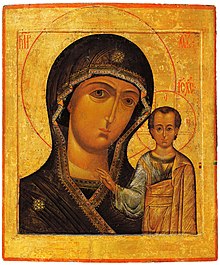
Our Lady of Kazan (Virgin of Kazan, Theotokos of Kazan), Казанская Богоматерь (Kazanskaya Bogomater: "Theotokos of Kazan") in Russian, is a close-up version of a Hodigitria icon that is one of the most venerated icons in the Russian Orthodox Church.  It is difficult to determine the exact history of this icon due to the many copies that were made of it.  Of the numerous ancient copies that exist today, there is still debate which one (if any) is the original.

According to tradition, the icon came to Kazan (a city in Russia) from Constantinople in the 13th century.  When Kazan was besieged by the Tartars in 1438, the icon disappeared until it was found buried in a garden by a young girl named Matrona on July 8, 1579, after the location was revealed by the Theotokos in a prophetic dream.  The icon was placed in the Church of St. Nicholas in Kazan, where it cured a blind man the next day; not only that, but the priest at this church, Hermogen, eventually became Patriarch of Moscow and All Russia.  It was by his doing, after his becoming Metropolitan of Kazan, that the icon was moved to the city's Cathedral of the Annunciation and July 8 was declared the feast day of Our Lady of Kazan.

In the centuries following, the icon (or a copy of it: there is debate) was processed and venerated during numerous military conflicts (including the Polish invasion of 1612, the Swedish invasion of 1709, and Napoleon's invasion of 1812), and Russia's success in these battles was attributed to the intercession of Our Lady of Kazan (thus adding nationalistic connotations to the icon).  During this time, the icon (or copy) was placed in increasingly more prestigious locations, first in a small chapel to the Virgin of Kazan built in the Moscow Kremlin, then, in 1638, to the Kazan Cathedral built for it in Moscow, and eventually, in 1812, after Napoleon's invasion, to a Kazan Cathedral built in St. Petersburg.

From this time, the history becomes even more clouded, especially since many copies were written, and nine or ten of these became wonder-working.  The copy in Kazan was stolen on June 29, 1904, and the copy in St. Petersburg disappeared after the October Revolution of 1917.  (According to some, this latter copy disappeared en route to Moscow and eventually turned up in New York City.) There is a report that a copy was processed during the Siege of Leningrad in World War II.

The most famous copy of the icon today is one from around 1730 that was acquired by the Blue Army of Our Lady of Fatima and enshrined in Fatima in the 1970s.  (One source says this is the same copy as the one that disappeared from St. Petersburg around 1917 or 1918.)  Wishing to return the icon to the Russia, Pope Bl. John Paul II was given this icon in 1993, after which it was placed in his private study for eleven years.  The Pope wanted to personally return the icon to the Russian Orthodox Church, but when his efforts failed, he instead gave the icon unconditionally to the Russian Church on August 26, 2004, when it was sent to Moscow after being venerated on the altar of St. Peter's Basilica.  (One source says the Pope in the end sent the icon instead of continuing to try to return it personally because he knew he was near death.)  The icon is now enshrined (next to a relic of the Virgin Mary's robe) in the Church of the Elevation of the Holy Cross in Kazan, part of the former Monastery of the Theotokos, which was built on the spot of the original finding of the icon by Matrona in 1579.  Kazan is now being turned into a pilgrimage site for all religions (since not only the Orthodox, but Catholics and even Muslims have a devotion to Our Lady of Kazan) which will hopefully help bring peace between them.  Our Lady of Kazan has two festal days for the Russian Orthodox: July 8th celebrates the Appearance of the Kazan Icon of the Mother of God in 1579, and October 22nd celebrates the Deliverance of Moscow From the Poles by the Kazan Icon in 1612.

In addition to the famous copy now in Kazan, there are two icons written in a style similar to Our Lady of Kazan that are now famous and wonder-working.  Our Lady of Sitka is attributed to the famous 18th and 19th century portrait painter Vladimir Lukich Borovikovsky.  Workers at the Russian-American Company gave the icon to the Cathedral of St. Michael the Archangel in Sitka, Alaska, in 1850.  It was originally part of the main iconostasis of the cathedral, but due to the many miracles attributed to it, it was eventually relocated to a special place of honor on the far left of the iconostasis.  It is also commemorated, along with Our Lady of Kazan, on July 8th.

 Our Lady of Sitka

Our Lady of Soufanieh is in the Soufanieh neighborhood of Damascus, Syria.  The icon itself is a small replica of Our Lady of Kazan bought in Sofia, Bulgaria, in 1980.  The owner of the icon is Myrna Nazzour, a Greek-Melkite Catholic mystic who has reportedly had five apparitions of the Virgin Mary (1982-1983), many ecstasies in which she received messages from Jesus Christ and the Blessed Mother, and five occurrences of the stigmata.  (As a side note, Myrna's messages from Christ and the Blessed Virgin received a Nihil Obstat from her bishop in 1987.)  Before all these experiences (except for one experience of Myrna's own body exuding oil during prayer), on November 27, 1982, the icon of the Virgin of Kazan began to exude oil.  Until November 26, 1990, the icon exuded oil following the rhythm of the liturgical year (except for a period from November 27, 1985, to November 25, 1986).  The icon exuded oil once again during Holy Week of the year 2001.  Aside from the original icon owned by Myrna, many photographic reproductions and replicas of the icon have exuded oil as well.  This oil has caused numerous miracles.

 Our Lady of Soufanieh

In conclusion to this rather long post, let us ask for the prayers of Our Lady of Kazan, and let us especially pray through her intercession for the reunion of the Russian Orthodox Church with Rome.

Our Lady of Kazan, save us!


Nota Bene: I consulted many websites for information on this post: Wikipedia, Orthodox Wiki, Ikons - Windows Into Heaven, Cleansing Fire, the Antiochian Orthodox Christian Archdiocese, the Orthodox Church in America (for feast day information), and Our Lady of Soufanieh.
 

Text ©2012 Brandon P. Otto.  Licensed via CC BY-NC.  Feel free to redistribute non-commercially, as long as credit is given to the author.


Wednesday, December 28, 2011

Iconic Icons: The Nativity


On December 25, Christians everywhere (and non-Christians as well, to an extent) celebrated the Nativity of Our Lord Jesus Christ.  Being one of the greatest feasts of the Church and one of the greatest events in the history of mankind, icons have been written to celebrate this glorious Birth.  The traditional style of the icon is attributed to the iconographer Andrei Rublev (who wrote the most famous form of the icon of the Trinity).

In the center of the icon is the center of history: Jesus Christ, as a Child, just as He was on the day of His Nativity.  The Son of God, Lord of the Universe, is just a small baby wrapped in swaddling clothes inside a manger (represented by the cave).  Next to Him is His Mother, the Theotokos, Mary, in her traditional coloring of blue robed in red, humanity robed in divinity through her Son's gift and grace.  In the cave with the Virgin and her Son are an ox and ass, representing the fulfillment of the prophecy of Isaiah:

"The ox knoweth his owner, and the ass his master's crib" (Is 1:3).

These two figures and the animals, inside a cave, are the essentials of the Nativity icon.  There are many other details that may be present in the icon, although their presence varies from icon to icon, due to the individual iconographer.  I will explain as many as I can find, though there may be other details in other copies of the icon.

Above the cave (or sometimes in a corner) is a star, the star that led the three Magi to Bethlehem.  Below the cave is a tree, representing the "Jesse Tree" (cf. Is 11).  Sometimes there are midwives, indicating that Christ's Birth was truly a human birth.  St. Joseph is often shown being tempted by an old man (or woman), which represents the devil tempting him with doubts about Christ's divinity and Mary's virginity.  (The copy of this icon that I have instead includes St. Joseph slightly away from the cave, worshipping the Child, with no devil in sight.)  The three Magi are often shown carrying their gifts of myrrh, frankincense, and gold, to Jesus in the cave.  Angels are shown, glorifying God for His great gift of His Son and for the Son's humbling of Himself to become a man.  Sometimes the angels are shown announcing the Good News of the Incarnation to shepherds.  Another figure sometimes includes is a boy sitting in a field, playing a pipe with numerous sheep around him: this symbolizes the joy the whole world experiences with the Incarnation of the Lord.

The many figures and details in this icon can have more symbolic interpretations, such as the cave representing Earth and its darkness representing the world's slavery to sin, which Jesus, the Light of the World, came to save us from.  Mary's posture, which is often reclining, looking concernedly towards St. Joseph, shows her trying to free her spouse from his doubts and temptations regarding the Incarnation.  In some copies of the icon, Mary is shown kneeling before her Son (as in my copy): I interpret this as worship of her Lord, though some say she still looks concerned about others' faith in the Incarnation.

All in all, the icon of the Nativity is very detailed (like those of many, if not most, feasts of the Church), and the amount of detail varies from copy to copy.  Despite all the many details, the icon's goal is to portray one key event: the Incarnation of the Son of God, His taking flesh in order to save us from sin and bring us to everlasting life.  As the Christmas Season, especially the Octave of Christmas, continues, let us continued to meditate on this glorious event, and let us continually thank the Lord for His most glorious salvation.

Lord Jesus Christ, Son of God Incarnate, have mercy on us!
Theotokos, Ever-Virgin Mary, Mother of the Word Incarnate, save us!


[Due to the large variety of differences in this icon, below is a small gallery of various copies of it.]

The copy attributed to Andrei Rublev


Similar to the copy I own
 
Ethiopian icon

Coptic icon

Icon from St. Catherine's Monastery on Mount Sinai


Nota Bene: The information for this post comes primarily from Orthodox Wiki and a page of the website of the Antiochian Orthodox Archdiocese of North America.  The Scripture quote comes from the Douay-Rheims translation.
 

Text ©2011 Brandon P. Otto.  Licensed via CC BY-NC.  Feel free to redistribute non-commercially, as long as credit is given to the author.