Showing posts with label St. Anthony the Great. Show all posts

Friday, July 18, 2014

Some Thoughts on Christian Community

http://en.wikipedia.org/wiki/The_Vine

"I am the Vine and you are the branches..."

All who have been baptized into Christ have been clothed with Christ, and not only clothed: indeed, they have become members of Christ, members of His Body, the Church.  "One cannot have God for his Father without having the Church for his Mother" (St. Cyprian).  "Wherever two or more of you are gathered, there am I in the midst of them."  So we proclaim when we venerate the Cross at the end of Liturgy: "Christ is among us."  "He is and will be."  So He is in the midst of the Church, and so He is in the midst of two or more of the baptized who call upon His name; then we could say that each group of two or more, each Christian community, are a form of mini-Church, a micro-ecclesia, which is united to the remainder of the Church.

Friday, May 30, 2014

"I Exorcise You, Spirit Unclean"

http://commons.wikimedia.org/wiki/Gospel_harmony
 
"I call upon You, God, Pantokrator, Lord Jesus Christ, Heavenly King:
I call upon You, the maker of heaven and earth.
I exorcise you, spirit unclean, according to the word of God, the maker of heaven and earth.
Be put to flight by the one who wraps himself in light as a cloak:
the one who alone has immortality and light unapprochable:
to Whom be glory and power unto the ages.
Amen."
--St. Epiphanius of Salamis

What St. Epiphanius' short prayer was written to do is something which the world has needed since the Garden: the exorcism of demons.  While sin is, of course, the choice of man, the demons play their part in trying to bend us toward sin, to constantly bombard us with temptation (think of C.S. Lewis' fictionalized account of this in The Screwtape Letters).  But God does not leave us to their whims: we are not abandoned into the hands of the "worldrulers," as St. Paul calls them.  Indeed, He gives us the power of His Spirit to drive them away from us.

Wednesday, May 28, 2014

The Catholicity of the Saints

http://www.touregypt.net/featurestories/catherines2-21.htm
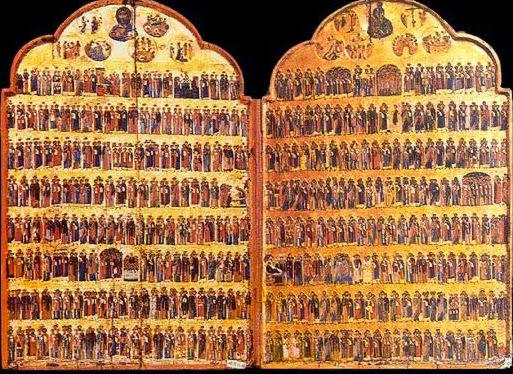
A Hagiologion (calendar of all the saints by feast day) from St. Catherine's Monastery on Mount Sinai (13th century)

"Resplendent with the brightness of beauty, and shining as unerring stars, you have made the Church of Christ a star-filled heaven on earth by the diversity of your lives."--Canon of the Sunday of All Saints, Ode 3

The many mansions in the Father's house welcome countless men and women from every land and tongue, every tribe and nation, every race and people.  Until we, God willing, are also there, we can never know the sheer number of those who have fallen asleep marked with the sign of faith, the multitude of those who are praising the Lord for eternity.  For though there are thousands and thousands of the Lord's servants that we know are in Heaven, there are innumerably more as well whom we shall not know in this life.

Sunday, June 10, 2012

Our Holy and God-Bearing Fathers: St. Makarios the Great


The Church has a devotion to those great men and women who went before them in the faith, teaching the Gospel fervently and helping others to deepen their living of the true Christian life.  In the Eastern Church, the title "our holy and God-bearing Fathers" is used for the great saints of the past.  In this series (which I will hopefully not give up on, as I have with some of my past series), I hope to introduce members of the Western Church to some of the great saints venerated in the Eastern Church and explain how powerful their memory is for the Eastern Church.  The first saint I will discuss is St. Makarios the Great.

St. Makarios (Macarius) the Great (295-392), also known as St. Makarios the Egyptian, St. Macarius the Spirit-Bearer, and the Lamp of the Desert, was a disciple of St. Anthony the Great, the first monastic.  His name means "blessed" in Greek, and it was chosen because his birth was such a blessing to his infertile parents, fittingly named Abraham and Sarah.  His father forced him to marry, but Makarios stalled the marriage by feigning sickness for a few days and then heading to the wilderness to relax.  In the wilderness, a Cherub led him up a high mountain and showed him the desert all around him, saying, "God has given this desert to you and your sons for an inheritance."  Upon returning from the wilderness, he learned his fiancee had died.  Soon afterwards, his parents also departed this life, and he gave away all his belongings to the poor.  The townspeople of Shabsheer, Egypt, where he lived, were astounded at his holiness, and they implored the bishop to ordain him.  St. Makarios was ordained and began to live in a small place outside the city built by the townspeople, where he helped attend to their spiritual needs.


Following a false accusation of unchastity, which St. Makarios did not deny but rather accepted the consequences of, he headed for Scetis, an area of Egypt where early monasticism flourished.  There he dwelt in the inner desert.  One day, he visited St. Anthony the Great, who lived nearby, and the latter bestowed the Great Schema (the highest degree of monastic tonsure) on St. Makarios.  Following this, he returned to the desert.  His holiness and monastic life attracted many men to follow his example, and a monastic community grew up around him, which built on the monastic foundations laid by Sts. Anthony the Great and Pachomius.  His community eventually became the present Coptic Orthodox Monastery of St. Makarios the Great.

In addition to his monastic life, St. Makarios also fought against Arianism, even being exiled for his support of the teachings of St. Athanasius.  After a miraculous exorcism performed by the saint, he was welcomed back from exile, returning to his monastic life.  St. Makarios passed over into eternal life in 392, at the age of 97.

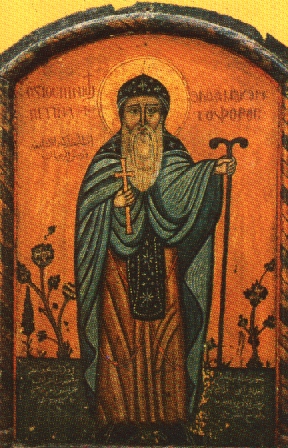
 Coptic icon of St. Makarios with Sts. Maximos and Domadios

There are two main aspects to St. Makarios' legacy.  First, his influence on the development and spread of monasticism is memorable due to the high importance of monasticism for Eastern Christian spirituality.  Second, the writings attributed to him have been very influential for centuries.  One letter of his, known by the Latin title "Ad filios Dei," seems to quite possibly be a genuine letter of his.  The other writings of his, the Great Letter and the Fifty Spiritual Homilies, are usually now referred to as written by "Pseudo-Macarius," but that does not stop their immense influence.  Those beginning the monastic life often read the Spiritual Homilies (or their paraphrase by St. Symeon Metaphrastes, found in Volume III of the Philokalia) to help them become accustomed to the ascetic lifestyle and its spirituality.

"The heart is Christ's palace: there Christ the King comes to take His rest, with the Angels and the spirits of the Saints, and He dwells there, walking within it and placing His Kingdom there" (Homily XVI).

St. Makarios with a Cherub

Apart from his writings, some of his prayers are in frequent use among Eastern Christians, especially during morning and night prayers.  The prayers are often focused deeply on repentance and protection from temptation.  The following prayer is common for use before heading to bed:

"O Eternal God and King of all Creation, Who have granted me to arrive at this hour, forgive me the sins that I have committed today in thought, word, and deed, and cleanse, O Lord, my humble soul from all defilement of flesh and spirit.  And grant me, O Lord, to pass the sleep of this night in peace, that when I rise from my bed, I may please Your most Holy Name all the days of my life and conquer my flesh and the fleshless foes that war within me.  And deliver me, O Lord, from vain and frivolous thoughts and from evil desires which defile me.  For Yours is the Kingdom, the power and the glory of the Father, Son, and Holy Spirit, now and always and forever and ever.  Amen."

Let us ask for the intercession of our holy and God-bearing Father St. Makarios the Great, that his prayers may help all monastics grow deeper in their angelic life, and that all of us may grow deeper in our deified life: St. Makarios the Great, pray for us!


Nota Bene: Information for this post comes from OrthodoxWiki and WikipediaThe quotes come from pages 569-570 and 57-58 of the Publican's Prayer Book by the Melkite Catholic Eparchy of Newton.  The Great Letter and Spiritual Homilies attributed now to "Pseudo-Macarius" can be found in a volume of Paulist Press' Classics of Western Spirituality series.
 

Text ©2012 Brandon P. Otto.  Licensed via CC BY-NC.  Feel free to redistribute non-commercially, as long as credit is given to the author.


Saturday, March 3, 2012

Spiritual Work in the Desert: Suggestions for Lent

Lent is a time of the desert.  In the desert, we lack what we previously thought we needed but truly did not: in the desert, we are stripped of excess.  Yet the desert is not just a place of aridity and ascesis: it is also a place of God. 

"Spiritual work is essential, it is for this that we have come to the desert."

Countless holy men and women went to the desert to be united with the Triune God: St. Anthony the Great, St. Mary of Egypt, Sts. Barsanuphius and John, the great Desert Fathers and Desert Mothers, St. Pachomius, St. Hilarion, and innumerable others.  The desert is a place where we can find Tabor and encounter Christ: in the desert we can become "partakers of the divine nature" (2 Pt 1:4).

During this holy season of Lent, let us not just strip ourselves of distractions and worldly goods, but let us enter deeper into our relationship with Jesus Christ, and let us fight harder in our spiritual battle.

Below is a list of suggestions for making this time in the desert a time of union with Christ, not just a time of ascesis.  They are not suggestions of what to give up: these are suggestions of what to add to our lives.
  • Daily Mass (or in the Byzantine Rite, the Liturgy of Pre-Sanctified Gifts on Wednesdays and Fridays)
  • Daily Rosary
  • Morning Prayer and Evening Prayer of the Divine Office (and extra Hours are always encouraged)
  • Daily additional Scripture reading (I highly recommend the Psalter reading group at Adventures of an Orthodox Mom, which you can still sign up for, even though it has already begun)
  • Daily spiritual reading (there are countless amazing works, though in this desert time of Lent, maybe the Sayings of the Desert Fathers, St. Athanasius' Life of St. Anthony, or the Letters of Sts. Barsanuphius and John would be apt suggestions; to focus more on spiritual warfare, Dom Lorenzo Scupoli's The Spiritual Combat or St. Catherine of Bologna's The Seven Spiritual Weapons may be useful)
  • Daily Examination of Conscience
  • Daily time for silent, contemplative prayer
  • Frequent listening to sacred chant (Gregorian, Ambrosian, Mozarabic, Greek, Russian, Slavic, Byzantine, Armenian, etc.)
  • Daily Holy Hour
  • Daily Akathist Hymn (to Christ, to the Theotokos, to any saint)
  • Weekly of any of these instead of daily
This list is just a skimming of some of the most prominent spiritual practices from both the Western and Eastern Church (mostly Western, since that is what I have the most experience with).  There are unimaginable depths to the Church's spiritual riches, and all of them may bring us closer to God (and if these riches are unimaginable, how much more unimaginable must the Lord of Hosts be!).  

May these suggestions help you as this holy season continues, and may you exit this sacred desert with truer faith, more certain hope, and more perfect charity.  God Bless.

St. Anthony of the Desert, pray for us!


Nota Bene: The quote is from Saying #108 of the Anonymous Series of the Apophthegmata Patrum, found in The Wisdom of the Desert Fathers, translated by Sr. Benedict Ward, SLG.
 

Text ©2012 Brandon P. Otto.  Licensed via CC BY-NC.  Feel free to redistribute non-commercially, as long as credit is given to the author.