Showing posts with label St. Augustine. Show all posts

Friday, June 6, 2014

"Guide Me in the Way Everlasting"

http://www.art-breastfeeding.com/rel1/v3.htm
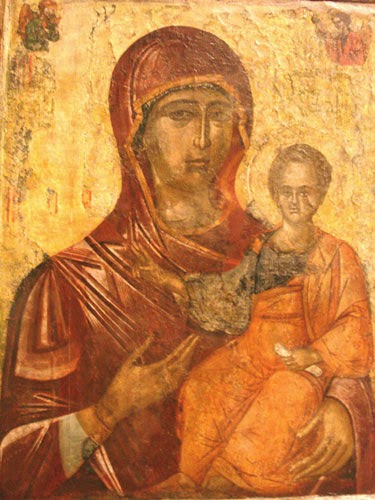
 A Hodigitria Icon, an icon of She Who Guides, from the National Museum of Art in Bucharest, Romania

"And see if a lawless way is in me, and guide me in the way everlasting."--Ps 138:24

The way of the Lord is an everlasting way, for He is everlasting, and if we hope in Him, we too shall become everlasting, for we shall have no end to joy.  If we trust in the Lord, an eternal Heaven awaits us, the eternal liturgy where men of all tribes and tongues and races and nations will praise the Lord unceasingly.  The way to this eternal liturgical rest is what we ask from the Lord in this psalm.

Friday, March 7, 2014

Married Priests


http://www.bellinghamherald.com/2014/02/28/3502910_married-dad-becomes-maronite-catholic.html
 Fr. Wissam Akiki greets his wife, Manal, following his ordination on February 27, 2014.

"The Lord confirmed that marriage is something of value…because he attended a wedding," as St. Augustine remarked, yet St. Paul declares, "It is well for a man not to touch a woman," and he comments, "I wish that all were as I myself am," that is, without a wife. The value of both marriage and celibacy has always been a part of Christian teaching, since Jesus Himself, who both announced the indissolubility of marriage and proclaimed that marriage will not be in Heaven. The way these two vocations interact with the separate vocation to priesthood has changed over the centuries and is dependent on circumstances.

Wednesday, March 5, 2014

The Exceeding Beauty of Creation


http://commons.wikimedia.org/wiki/File:Creation_of_World_icon_%28Russia,_end_19_-early_20_c.,_private_coll.%29.jpeg

"And God saw everything, which He made, and behold! it was beautiful exceedingly."--Gen 1:31

Tradition lends a new dimension to the Faith which can easily be missed.  Think, for example, of the account of creation in Genesis, in which each day it is repeated: "And God saw, that it was good."  A quick comparison of English Bible translations shows how ubiquitous the use of the word "good" is in these passages, with only one rebel saying "He was pleased" instead.  Even the Vulgate speaks of how God's creation is "bona."  These all translate well the Hebrew טוב, "pleasing, good, agreeable."  Yet Tradition gives us a rich nuance which should not be avoided.


Wednesday, January 29, 2014

On Ps 109:7: "He will drink from the brook by the way..."

My wife and I were praying the Hours recently, and the reading of Psalm 109 (110) was proscribed.  "The Lord says to my lord: 'Sit at my right hand...'"  The light of grace has made it abundantly clear to Christians of all times, beginning with the Apostles and Evangelists themselves, that this psalm relates to Christ's "Divine Begetting from the Father and His coming in the flesh" (St. Athanasius).  Thus its announcement of Jesus the Messiah is quoted frequently in the New Testament.  With the light of the Spirit, the key message of most of the verses of this psalm are clearly evident, yet the last line is still "deeply enigmatic," as Pope Benedict XVI admitted.  My wife encountered this enigma and asked me for clarification on this text.

"He will drink from the brook by the way; therefore he will lift up his head."  These words come following the description of Jesus' victorious kingship, how He executes judgment and shatters chiefs.  It is after His destruction of His enemies that He drinks from the brook.  Pope Benedict explained it in this way: "At a moment of respite and rest, he quenches his thirst at a stream, finding in it refreshment and fresh strength to continue on his triumphant way, holding his head high as a sign of definitive victory."  My first thoughts bent also in terms of respite and rest from the battle.  The brook is particularly "by the way"; it is in the open, not hidden.  Thus it shows confidence to partake of this unguarded water, leaving oneself vulnerable.  Yet God need not fear, for His enemies cannot overtake Him.  Not only that, but He has already crushed and shattered them: thus there is no one to be guarded from, and He may freely partake of the stream.  The lifting up of His Head is a triumphant sign.

Tuesday, April 10, 2012

On the Conspicuousness of Christians

I was recently instructed that, as a catechist, I should blend myself into my students, to make myself one of them, in order to make them accept me.  If I was too "different" or too blatant in my Catholicism, I would not be accepted.  Instead, I should work from within them, almost in an undercover way.  The thing is, it is difficult to be undercover when your students know you are teaching them the faith.  I can understand my professor's point: the members of the Church should integrate themselves into society so they can change it from within.  It is not an outside force that will bring change, but a force hidden within, such as hidden yeast leavens dough.  We are to be Trojan horses: we must sneak under their radar and then slowly purify their drinking water with the nectar of the faith.  The problem is this: I do not see this as an effective method.

I apologize if I am being proud: I am just giving my opinion on an issue that directly affects how I should live and teach.  If you have any ideas in this area, please tell me: perhaps your reasons will be more convincing to me than my professor's.

The main issue is that I find conspicuous Christians more the norm among the saints than yeast Christians.  I see more saints acting as armored knights than as wooden horses.  Think of the model of all Christians: Jesus Christ, the Son of God, risen from the dead.  He did not hide His faith: He drove the money-changers from the Temple, He performed miracles with countless witnesses, He preached day after day in the synagogues and the Temple (though His enemies were too cowardly to arrest Him then).  Some might say, "But He was God.  Surely God cannot hide Himself.  But we are only men!"  Have not men done the same, though?  Did not St. Paul rejoice over the countless sufferings he bore for preaching the Gospel openly?  He was even stoned to death in Derbe, yet He continued to preach.  Listen to the list of his troubles:

"Five times I have received at the hands of the Jews the forty lashes less one.  Three time I have been beaten with rods; once I was stoned.  Three times I have been shipwrecked; a night and a day I have been adrift at sea; on frequent journeys, in danger from rivers, danger from robbers, danger from my own people, danger from Gentiles, danger in the city, danger in the wilderness, danger at sea, danger from false brethren; in toil and hardship, through  many a sleepless night, in hunger and thirst, often without food, in cold and exposure" (2 Cor 11:24-27).

 Icon of St. Paul by Andrei Rublev

If he had merely kept his conversion secret and continued to act as the zealous Pharisee and pupil of Rabban Gamaliel that he was, or if he had remained an inconspicuous believer, would he have been put through so much suffering?  No!  But with all his suffering came conversions, countless, countless conversions.  If he were not so blatant in his faith, would he have converted so many?  I cannot say for sure, but I would assume not.

Think of the rest of the apostles as well: all except John the Theologian were martyred for their faith, even the thrice-denying one, Pope St. Peter.  "But they were apostles, personal friends of Christ!" some may respond.  Then recall all the countless martyrs of the early Church, such as the ones remembered in the Roman Canon:

"Ignatius, Alexander, Marcellinus, Peter, Felicity, Perpetua, Agatha, Lucy, Agnes, Cecilia, Anastasia."

Yet some might say, "those were still in the early Church.  Times changed, and so did our way of living the faith."  Does a change in culture mean we hide our faith?  By no means!  In extreme circumstances, some may be called to live underground in order to retain the faith from oppressive governments, but in general, we must not hide our faith: we should rather boast in the Lord!  The Church's record of conspicuous martyrs also does not end with the end of the Apostolic Age: martyrs have continued for centuries and centuries, and not only martyrs to the death, but martyrs to reputation, comfort, and fame.  Even in the past century, we have had Servant of God Óscar Romero, Bl. Jerzy Popiełuszko, Bl. Miguel Pro, and St. Maria Goretti.

 Servant of God Óscar Romero; Blessed Jerzy Popiełuszko

What about those who were not martyrs, but still lived their faith in the sight of all?  There are many: the mendicant orders of St. Dominic and St. Francis, pontiffs such as Leo XIII, Pope St. Pius X, and Servant of God Pope Paul VI (called a "white martyr" for the vicious response to his defense of sexual morality, Humanae Vitae), and workers with the poor such as Servant of God Dorothy Day and Bl. Mother Teresa of Calcutta.  Among the Russians, there is even a group called the yurodivuie, "fools for Christ's sake," such as St. Francis of Assisi, St. Benedict Joseph Labré, and St. Simeon the Holy Fool (St. Simeon Salos).  If the saints are any indication, Christians have never been known for their inconspicuousness.

That leads us back to the practical question: should we lived as conspicuous Christians or not?  In this way we would live not only in imitation of our Saviour Jesus Christ and His holy apostles, but in imitation of countless saints through the millennia.  Though our actions may seem foolish to the world, they are glorious to Christ, such as St. Isidore of Pelusium (St. Isidore Pelousiotes) wrote,

"Imitate the simple garments of Christ.  For if the roughness in apparel here on earth is foolishness, wearing the garment of light in heaven is certainly not" (Epistle 74).

We should not be afraid even if we must suffer for our conspicuousness.  As St. Gregory the Theologian exhorts,

"Teach in the temple, drive out the traders in divine things, be stoned if it is necessary you suffer this" (Oration 38.18).

St. Gregory the Theologian

Some may say that in doing this, in acting conspicuous, we are driving away those who would be converted by us.  We are showing the "radical" side of Christianity, which only a few are called to.  It is true that only some are called to the extent of martyrdom, but all are called to preach with their lives, if not also with their words.  Origen even says that it is better to preach with words we don't fully believe than to hide the faith in our hearts (vid. Exhortation to Martyrdom V).

In the end, is our faith one of private devotion, to be gently shared among others as a slowly creeping moss?  No!  Though some are called mainly to work, with direct preaching being rare, all are called to live openly and boldly for Christ.  As the axiom often mis-attributed to St. Francis of Assisi states, "Preach the Gospel at all times; when necessary, use words."  I believe I am called to be a catechist, though: I am called to be an example of the faith lived out for students to see.  When they see me, should they see a man who is only Christian in his intellect?  Should they not be able to tell if I'm a Buddhist well-trained in Catholic doctrine or a practicing Catholic?  Should they see me as no more than a neutral, politically correct textbook in human form?  By no means!

I will not hide my faith under a bushel basket.  When I teach, and even in general when I live, I will wear my faith on my sleeve (literally, in a sense, with my komboskini).  I will not hide my faith and water down my Christian life in order to appeal to the masses.  Should I dilute my Catholicism in order to convert others?  Then what am I converting them to but a crippled version of the faith, a version crippled by my "politically correct" witness?  Like the saints, who converted millions in their Christian zeal, I, too, will strive to live my faith as openly and zealously as possible in the hopes of converting my students.  The fight for conversion is a war, a war "not against flesh and blood, but against the principalities, against the powers, against the world rulers of this present darkness, against the spiritual hosts of wickedness in the heavenly places" (Eph 6:12).  It is a war of the City of God against the City of Man, as in St. Augustine's De Civitate Dei, a war of the culture of life against the culture of death, as in Pope Bl. John Paul II's Evangelium Vitae.  Some may be called to hide themselves amongst the enemy troops in hopes of gaining conversions, but I will be a warrior against the enemy, as the countless saints before me have been.  I will be a conspicuous Christian.  And if I suffer for my convictions, for my true living of the faith, then praise God!  (How I hope I can keep that sentiment when the day of suffering comes!)  Then I just fulfill the dictum of St. John Climacus:

"War against us is proof we are making war" (Ladder, Step IV).

I am sorry for my rampant pride through this post.  I merely wish to express my convictions on this matter.  Please listen to my message, though it may be clothed in the words of pride.  May each of those moments of pride merely reinforce the fact that I am a sinner in need of mercy.  God Bless.

 St. Simeon Salos, pray for us!


Nota Bene: Information from this post comes from Wikipedia (Text and rubrics of the Roman Canon, Foolishness for Christ, and above-sourced articles).  Sergius Bolshakoff's Russian Mystics also gave me information on yurodivuie.  The quote from St. Isidore Pelousiotes is from Nicodemus the Hagiorite's A Handbook of Spiritual Counsel, Chapter VIII, translated by Peter A. Chambers.  The quote from St. Gregory the Theologian comes from Sr. Nonna Verna Harrison's translation of his Festal Orations.  The quote from St. John Climacus comes from his Ladder of Divine Ascent, translated by Colm Luibheid and Norman Russell.
 

Text ©2012 Brandon P. Otto.  Licensed via CC BY-NC.  Feel free to redistribute non-commercially, as long as credit is given to the author.


Monday, January 30, 2012

Litany for Persecutors

I vilify persecutors.  I must admit that this is a habit I have, and one that I have trouble breaking.  When I hear of Kathleen Sebellius and the HHS contraceptive mandate, I vilify Ms. Sebelllius.  When I hear of attacks on Nigerian Christians by Boko Haram, I vilify militant Muslims.  Now, I don't say that they are going to hell: I know I can't judge that at all.  Though I sometimes speak in generalizations (such as just talking about "Muslims" when I discuss teachings of the Qur'an made prominent by militant groups or "Jesuits" when I discuss the many heretical teachings of individual Jesuits throughout the past few decades), I know that they're generalizations: not all Muslims want to kill me or subdue me with a jizya, and not every Jesuit is a Resurrection-denying, "historical Jesus"-promoting heretic.  Yet I have this terrible habit of vilifying those who commit manifest evil acts, particularly high-profile ones that they seem proud of.

The thing is, in my prayer last night, I came across this line from St. Paul that smacked me upside the head in this area:

"Bless those who persecute you; bless and do not curse them" (Rom 12:14).

That verse made me realize that I need to try to change.  Though I will of course not stop pointing out evil acts, I will make an effort to stop vilifying those who perform them.  I will try to hold faster to that great dictum of St. Augustine: hate the sin, love the sinner.  One idea I have for how to love those who commit evil acts is taken from a few verses later in St. Paul's chain of exhortations:

"'If your enemy is hungry, feed him; if he is thirsty, give him drink; for by so doing you will heap burning coals upon his head.'  Do not be overcome by evil, but overcome evil with good" (Rom 12:20-21).

What is it that those who commit evil deeds seem to be hungering for and thirsting for the most?  The Truth, that is, Jesus Christ.  Thus I have resolved to pray for those who commit evil acts, especially those who persecute Christians (either directly or indirectly).  To do this, I have decided to write a short litany in the style of the litanies from the Divine Liturgy of St. John Chrysostom.  Feel free to take this idea and switch out the petitions for anyone you specifically want to pray for, and feel free to make it longer.  I know I will not keep the same list of petitions forever.  I hope that you will pray this with me, and I hope that you will pray for me, that I may be more charitable and less vilifying.

In peace, let us pray to the Lord.  Lord, have mercy.
For our President, Barack Obama, and for all elected authorities, let us pray to the Lord.  Lord, have mercy.
For Kathleen Sebellius and the Department of Health and Human Services, let us pray to the Lord.  Lord, have mercy.
For the courts of the United States of America, let us pray to the Lord.  Lord, have mercy.
For Planned Parenthood and for all abortionists and clinics, let us pray to the Lord.  Lord, have mercy.
For those who wish to redefine marriage, let us pray to the Lord.  Lord, have mercy.
For those who wish to silence Christians, let us pray to the Lord.  Lord, have mercy.
For the government of Britain, let us pray to the Lord.  Lord, have mercy.
For all governments persecuting Christians, let us pray to the Lord.  Lord, have mercy.
For the Muslim Brotherhood of Egypt, let us pray to the Lord.  Lord, have mercy.
For Boko Haram, let us pray to the Lord.  Lord, have mercy.
For the officials in Iraq, let us pray to the Lord.  Lord, have mercy.
For the government of Saudi Arabia, let us pray to the Lord.  Lord, have mercy.
For persecutors of Christians in Sudan, let us pray to the Lord.  Lord, have mercy.
For practitioners of sharia law, let us pray to the Lord.  Lord, have mercy.
For blasphemers, heretics, apostates, and schismatics, let us pray to the Lord.  Lord, have mercy.
For atheists and secularists, let us pray to the Lord.  Lord, have mercy.
For all persecutors of Christians in any respect, let us pray to the Lord.  Lord, have mercy. 
Protect us, save us, have mercy on us, and preserve us, O God, by Your grace.  Lord, have mercy.
Remembering our most holy, most pure, most blessed and glorious Lady, the Mother of God and ever-Virgin Mary with all the saints, let us commit ourselves and one another, and our whole life, to Christ, our God.  To You, O Lord.

I hope this litany (or at least the concept of it) helps you.  Again, please pray for me, that I may grow in charity, and pray for persecutors of Christians, that they may come to the Way, the Truth, and the Life, Our Lord Jesus Christ, Son of God.  Let us end by invoking the prayers of St. Stephen, who prayed as he was martyred, "Lord, do not hold this sin against them" (Acts 7:60).  Thank you for reading, and God Bless.

St. Stephen the Protomartyr, pray for us!


Nota Bene: All Scripture quotes are from the Revised Standard Version: Catholic Edition.  The litany is based off of the Litany of Peace from the Divine Liturgy of St. John Chrysostom (with the prayers in italics taken directly from the liturgy).  My source was the Study Text of the Ruthenian Divine Liturgy of St. John Chrysostom, with the prayers taken from the 2009 Pastoral Update (see the link to the pdf in the first post on the page I linked to).
 

Text ©2012 Brandon P. Otto.  Licensed via CC BY-NC.  Feel free to redistribute non-commercially, as long as credit is given to the author.


Monday, January 23, 2012

"Come After Me": Poems in Response

"Come after Me, and I will make you to become fishers of men."--Mk 1:17

This command of the Lord was heard yesterday (though in the New American Bible translation, not the Douay-Rheims) during the Gospel reading at Mass.  Though it was addressed to Simon (Peter) and Andrew, it is in some sense addressed to all of us: we are all called to follow the Lord.  While some (that is, religious and consecrated virgins) answer this call by "[following] the Lamb whithersoever He goeth", the rest of us are called to follow Him "not whithersoever He shall have gone, but so far as ever [we] shall have been able" (Rev 14:4; St. Augustine, On Holy Virginity 28).

In response to this call to be followers, we are to draw close to Christ, so close that to be apart from Him is painful to us.  (Thus the absence of Christ's presence, or the feeling of it, is part of the dark night of the soul.)  Many spiritual writers have expressed this fervent desire to be with Christ and the excruciating pain of feeling apart from Him, and some of expressed it in poetry.  Two great examples of poems expressing this theme can be found in the poetry of the Spanish Golden Age.

The first example is a hymn by Fray Damián de Vegas, a friar (who I believe was Augustinian) from around the late 16th century, entitled "Estate, Señor, conmigo" ("Stay, Lord, With Me").  This hymn is included in the Spanish version of the Liturgy of the Hours.  The hymn entreats the Lord to stay with us and take us with Him wherever He goes.

Estate, Señor, conmigo
siempre, sin jamás partirte,
y, cuando decidas irte,
llévame, Señor, contigo;
porque el pensar que te irás
me causa un terrible miedo
de si yo sin ti me quedo,
de si tú sin mí te vas.

Llévame en tu compañía,
donde tú vayas, Jesús,
porque bien sé que eres tú
la vida del alma mía;
si tú vida no me das,
yo sé que vivir no puedo,
ni si yo sin ti me quedo,
ni si tú sin mí te vas.

Por eso, más que a la muerte,
temo, Señor, tu partida
y quiero perder la vida
mil veces más que perderte;
pues la inmortal que tú das
sé que alcanzarla no puedo
cuando yo sin ti me quedo,
cuando tú sin mí te vas. Amén.


Stay, Lord, with me
always, without ever leaving,
and, when You decide to go,
take me, Lord, with You;
because the thought that You will leave
causes me a terrible fear
that I without You will remain,
that You without me will go.

Bring me in Your company,
wherever You go, Jesus,
because well I know that You are
the life of my soul;
if You do not give me life,
I know that to live I cannot,
nor if I without You remain,
nor if You without me go.

Therefore, more than death,
I fear, Lord, Your parting
and I want to lose my life
a thousand times before losing You;
for the immortality You give
I know that obtain it I cannot
when I without You remain,
when You without me go.  Amen.

The second example is an anonymous sonnet (Petrarcan sonnet, not Elizabethan sonnet) from the late 16th century.  It is been attributed to many famous Spanish writers and saints, including St. Ignatius of Loyola, St. Francis Xavier, the Golden Age poet Lope de Vega, and Doctors of the Church St. Teresa of Ávila and St. John of Ávila.  Despite all the attributions, it still remains anonymous.  This poem is less related to the theme of following Christ and being with Him: instead, it is about why to follow Christ.  The poet declares that he follows Christ not for any benefit he gains but instead solely because of Christ's identity.  While it does not focus on the theme of following Christ "whithersoever He goeth," it explains the mindset behind why one would follow Christ: in a sense, it could be seen as the mindset of Simon and Andrew in the verse that prompted this post.  Here, then, is the sonnet "A Cristo Crucificado" ("To Christ Crucified").

No me mueve, mi Dios, para quererte 
el cielo que me tienes prometido;
ni me mueve el infierno tan temido
para dejar por eso de ofenderte.

Tú me mueves, Señor; muéveme el verte
clavado en una cruz y escarnecido;
muéveme ver tu cuerpo tan herido;
muévenme tus afrentas y tu muerte.

Muéveme, en fin, tu amor, y en tal manera
que aunque no hubiera cielo, yo te amara,
 y aunque no hubiera infierno, te temiera.

No tienes que me dar porque te quiera
pues aunque cuanto espero no esperara,
lo mismo que te quiero te quisiera.


It does not move, my God, to love You,
the Heaven that You have promised me;
nor does it move me, the hell so feared
to cease for that offending You.

You move me, Lord; it moves me to see You
locked in a cross and incarnate;
it moves me to see Your Body so wounded;
they move me, Your affronts and Your death.

It moves me, finally, Your love, and in such a way
that even if there were no Heaven, I would love You,
and even if there were no hell, I would fear You.

You do not have to give me because I would want You
because as much as I hope I would not hope,
the same that I want You I would want You.

[Nota Bene: The verb I translate "to want" can also mean "to love."]

I hope these poems will help your spiritual life, and I hope they will help you to, like the apostles Simon and Andrew, respond to Christ's call, "Come after Me."  Thanks for reading, and God Bless.

Holy Brother Apostles Peter and Andrew the Protoclete (First-Called), pray for us!


Nota Bene: The hymn by Fray Damián de Vegas is from the hymnal Cantad a Dios con salmos, himnos y cánticos inspirados, published by Magnificat.  The anonymous sonnet is from Anthology of Spanish Golden Age Poetry, edited by R. John McCaw and Kathleen Thornton-Spinnenweber.  Information on proposed authorship for this sonnet is from Wikipedia and this page.  The quote from St. Augustine is from a translation by Rev. C.L. Cornish, M.A. in Nicene and Post-Nicene Fathers, Series One, Volume 3, retrieved from The Faith Database.  The English translations of the poems are mine: I apologize for any bad translation work.
 

Text and Translations ©2012 Brandon P. Otto.  Licensed via CC BY-NC.  Feel free to redistribute non-commercially, as long as credit is given to the author.