Showing posts with label Origen. Show all posts

Wednesday, March 29, 2023

Origen of Alexandria: Commentary on Proverbs (Part Two)

Fragments from the Commentary on the Proverbs of Solomon

Origen of Alexandria

(185-283)

Part Two

For Part One, see here.  For selections from the Septuagint version of Proverbs, see here.  The source for this selection is PG 13:25D-33D.


Crown of graces (Prv 1:9): the enclosure[1] of the virtues, through which they are bound to each other.

Golden collar around your neck (Prv 1:9): he calls the surrounding splendor and circular blaze of the divine words “golden collar.”   And he calls the mind “neck.”

We will remove his memory from the earth (Prv 1:12): for those who say these things are also those saying: This is the heir; come, let us slay him, so that the inheritance will become ours (Mt 21:38).

And cast your lot among yourselves[2] (Prv 1:14): leaving that society, be among yourselves, make the Sabbath among yourselves, prepare the unleavened bread among yourselves, and may you keep the other parts of the law.

For they are partakers of slaughter (Prv 1:18): for God is the giver of goods, but we are the causes of evils, that is, of harmful things.  And you can also say these things about those partaking in the blood of the Jews, of the prophets, and of Christ Himself.

Wisdom hymns in the exit-ways (Prv 1:20): being made silent by a wise man, she does not hymn; but, having an exit, she hymns.

For it shall be, when you call upon me (Prv 1:28): for thus we call upon the Lord, Christ being wisdom.  Thus the one calling upon Christ, if he knows who He is, calls upon wisdom, understanding, holiness, righteousness, and every virtue, and if not with lips, then with deeds.  But let us not become such a kind of person that He will not listen when we call upon Him.

If, having received the saying of my commandment, you hide it with yourself (Prv 2:1): for someone hides it, not doing this for empty glory, but being eager to be overlooked.

Then you will understand fear of the Lord (Prv 2:5): see, then, after how much we will understand fear of the Lord; for it is also obscure, as is made clear by the simpler ones; for some are to be seen fearing the Lord among those who ought not, and some not fearing, among those who ought.

And give your voice to understanding (Prv 2:3): for each gives his own voice to something, be it to wrath, when he speaks of it, or to sorrow, or to sexual immorality.  But the blessed dedicates all his voice to the Lord, so that what he speaks is wisdom.  And as another seeks silver, so should you seek wisdom, being, as it were, silver-loving[3] in this.

Let evil council not seize you (Prv 2:17): those outside the Church have proclaimed one thing at the beginning, another at the end; for, at the beginning, they desert idolatry and approach the Maker, then, being changed, they reject the Old Scripture, opposing it to elementary newness.[4]  But for ecclesiastical teachers, the ends are in symphony with the elements in the beginning.

And let your heart guard my sayings (Prv 3:1): after the precepts and prohibitions of the law of God, the sayings of the wisdom of God announce the unfalse knowledge of the things that are.  Such is the Out of Sion the law will go forth, and the word of the Lord out of Jerusalem (Is 2:3).  For the one keeping the laws will acquire wisdom.  For sow, it says, righteousness among yourselves; you will gather at the season of life (Hos 10:12).  Then, after the action, it adds: Light in yourselves the light of knowledge (Hos 10:12).[5]

Provide for good things before the Lord and men (Prv 3:4): if you do what is done in wisdom, you will be a son of God, as is said: You have done all in wisdom (Ps 104:24).

Honor the Lord from your righteous labors (Prv 3:9): the godly Scripture usually uses the name “honor” for “gift”; for it says, Honor widows, those who are truly widows (1 Tim 5:3), instead of “Give,” not saying “almsgiving,” lest it humiliate the widow.  And the Savior, too, says: It is written in the law: “Honor your father and your mother” (Mt 19:9), and the rest.  For it says from righteous labors, lest it be from robbery and greed.  And let no one shrink from giving: for he has no defense after the widow in the holy Gospel tossed in all of her life, and was justified, not above those tossing in the proceeds of robbery, but above those tossing in the proceeds of excess (Lk 21:1-14).  For all giving to God is a work of sober-mindedness and the other virtues.  For it is necessary, too, to give first-fruits from all produce to the Church and to the poor, and, too, from the appointed sleep, to give first-fruits of prayer to God, and it is fitting to give the first-fruits of words: psalms.  For thus it has been said to you, And blessed your storehouses and your remnants (Dt 28:5)—and he speaks of the things of the soul.

God founded the earth by wisdom (Prv 3:19): but the faithful soul is also earth, bearing fruit a hundred-fold.  For she becomes wise from fatness, which is wisdom, founding herself upon that wisdom of God.  For she establishes the entrance of teaching upon it, forming the fastness with wisdom, and she ever completes the prepared heaven, purest creation, dwelling-place of angels and holy minds.  Receiving the sense of what is, and understanding the exactness of things, she begins to divide and dissect them.

Make your way far from her (Prv 5:8): he calls “way” the mind making its way to virtue, and he commands that virtue separate from evil.

For woman catches the precious souls of men (Prv 6:26): and the soul caught by woman is precious by nature; for it is not earthy by nature.  Or, since the mind and the soul of the manly[6] are precious, she likewise catches these.

I was that in which He rejoiced (Prv 8:30): the “I was” does not indicate “time” in regards to God; for it is timely when it indicates something subject to time, like “I was in the agora.”  For if she was harmonizing (Prv 8:30) with the beginning-less God, she, too, is eternal.

It enriches (Prv 10:22): if everyone blessed by the Lord is rich, and those walking in the law of the Lord are blessed by the Lord, and the prophets walked in the law of the Lord, therefore, they were rich.

In laughter the senseless does evil things (Prv 10:23): doing evil things, he takes pleasure and rejoices.  But wisdom in a man gives birth to sense (Prv 10:23), practical virtue.

The one not conversing with his own house will inherit winds[7] (Prv 11:29): our house is God, in Whom we move and are (Acts 17:28).  Therefore, the one not walking in the commandments of God will be a co-heir with the opposing powers.

From the fruit of righteousness grows the tree of life (Prv 11:30): the fruit of righteousness is the end of virtue.  One has as many trees of life as he has fruits of righteousness.  This tree of life is the one that grew in the midst of paradise, which Adam was forbidden to touch after sin, tossing away the seeds of righteousness, from which grows the tree of life. 

The wrath of the king is the angel[8] of death; but the wise man will calm him (Prv 16:14): since the holy one is passionless, or the wrath allegorical.

But in the places of the impious, men are captured (Prv 28:12): for their places are also the gatherings of heretics.

And three things are impossible for me to understand (Prv 30:18): impossible is it for the beginner to bring this proposition to knowledgeable thought,[9] and impossible is it for man to contemplate and understand the things beyond man, due to care for the fleshy, even if angels stand before him; impossible is it for someone to understand, too, what has never happened, nor could happen, such as, that three would be four.  Therefore, this seems said about things which are not.  For not losing track of the eagle’s trail in flying around the air, analogous to those losing track of the trails, in the sandy earth, of those who walked upon it, is impossible to understand; so, also, with a serpent: in soft earth, it is possible to see the paths, but not on the rock (Prv 30:19).

And the paths of the seafaring ship (Prv 30:19): and perhaps “ship,” in these words, is said of Jesus and His disciples, and perhaps of them alone; not seafaring: for Immediately the ship was on the land, to which they were going (Jn 6:21), by godly power.  For the ship not bearing Jesus is searfaring, and this is always shaken about by opposing spirits.  And since the things of life are vanity, always seafaring, and no one among men is approaching eternal life, their paths cannot be understood.  Therefore, no foreign work of piety is left by the glorious kings or princes of the earth after death.  For quenched was their glory.  For also unknown, it says, are the ways of man in youth (Prv 30:19), burning with desires due to unstable manners, and those of the adulterous woman (Prv 30:20), likewise, due to shamelessness.  For this is the Church of the nations,[10] which, after being washed through Baptism, says that it has done nothing untoward.  But the righteous one is not in youth, since having been perfected in a few, he fulfilled long times (Wis 4:13).  Such, also, is every adulterous woman, who is estranging herself from the bridegroom, and a soul abandoning her man, and going after lovers.

And it marched out,[11] in good order, at the first command (Prv 30:27): and the locust is praised as “good-ordered,” having trusted in the command of God’s words.  Such a one is the Church: through looking down upon men, she is compared to the locust, how it looks down at living upon earth; and through going along after Jesus and not being scattered, but putting on the armor of God, so that she would resist the methods of the devil (Eph 6:11), the Church is marching forth in good order at the first command; and she is unruled[12] by Pharaoh, but not by God, and the labors of the Egyptians are handed over to her.[13]  Similarly, then, to our not being ruled in opposition to Christ’s rule, unruled is the locust.  For it has no leader, like the bees, but each leads.  These are the resolutions lifting us up from earthly things, leading to ordered life.  And the locusts, whosoever want to fly by their own minds, being unable, run a little along the ground.  But if they share in the act, they are brought together into one active order.

And the he-goat leading the herd (Prv 30:31): in three ways[14] the he-goat is interpreted, according only to the phrase leading the herd: growing and fulfilling it and leading it to the pastures in the heights.  For no herd of animals thus comes up to the heights.  Such is the one leading Christ’s flock, bringing them, in a herd, to the height.  In another way, the he-goat is a type of Christ, being offered for sins.  The whole throng of the pious follow Him, being in the height.  


[1] Περιοχη means generally refers to the boundaries separating off a portion of something; it can mean “circumference,” “compass” or “extent,” “inclusion,” as well as a “fence” or “fortification.”  It can even refer to a section of a book.

[2] The common Septuagint text instead reads “us” (ημιν) instead of Origen’s “you” or “yourselves” (υμιν); in Greek, these two words are only one letter different, and, in some pronunciations, they sound identical.

[3] This is the literal meaning of the word (φιλαργυρος), typically translated as “greedy.”

[4] Probably a reference to the Marcionites, who rejected the Old Testament as depicting an evil creator god, and instead proclaimed the God of the New Testament alone (though their New Testament only include a shorter version of Luke and ten of St. Paul’s epistles).  They called the god of the Old Testament “the Maker” (Δημιουργος), the same word Origen uses earlier in this sentence. 

[5] This is the Septuagint’s phrase; most modern translations, based on the Masoretic Text, are different: “break up your fallow ground” (RSV-CE).

[6] This is the literal meaning of ανδρειων; the concept of ανδρεια, “manliness,” looms large in the Fathers, connoting courage, fortitude, resistance to temptation, strength in asceticism.  It was not solely the domain of men, either: St. Gregory of Nyssa praises his sister Macrina for becoming “manly” in virtue, so much so that “I do not know if it is proper to call her ‘woman’ after her nature, she who became above her nature” (Life of Saint Macrina, PG 46:960B).

[7] In the main Septuagint text, this is the singular “wind,” not plural “winds.”

[8] Or, “messenger.”

[9] This phrase (αδυνατον εις νοησιν επιστημονικην εισαγομενω θεωρημα) is unclear in meaning.  Θεωρημα means a “sight,” or an “object of contemplation,” or a “speculative proposition”; επιστημονικος means “capable of knowledge” or “scientific.”  The Latin translation included in the Patrologia Graeca renders it this way: “for the one who is first introduced, it is impossible to so understand this proposition that he would have knowledge [scientiam] of it.” 

[10] That is, the Gentiles.

[11] The main Septuagint text has “it wages war” (στρατευει) instead of “it marched out” (εκστρατευει).

[12] This is from the first part of cited verse: “Unruled is the locust, and it marches out, in good order, at the first command” (Prv 30:27).

[13] Probably a reference to the despoiling of the Egyptians’ jewelry by the departing Israelites (Ex 12:35-36).  In his Letter to Gregory Thaumaturgos §2, Origen famously used this passage as an allegory of how Christians can use the riches of pagan philosophy and literature, thus “despoiling them.”  See the English translation here.

[14] The three interpretations appear to be 1) the he-goat actively leads the herd to the heights, to which they wouldn’t go on their own; 2) the he-goat is sacrificed (on the height?), like Christ; 3) the he-goat is on the height, and the herd spontaneously goes up to him.

Translation ©2023 Brandon P. Otto.  Licensed via CC BY-NC.  Feel free to redistribute non-commercially, as long as credit is given to the translator.

Thursday, March 16, 2023

Origen of Alexandria: Commentary on Proverbs (Part One)

Introduction

Origen has the dubious claim of both writing theology worthy of a Doctor of the Church and sowing the seeds of the wildest of heresies.  While being perhaps the first to schematically discuss the spiritual senses of Scripture, in the same work (On First Principles), he also theorizes the reincarnation of souls in various lifeforms, from devils, through rocks and animals, to humans, and even to angels, and he preached a final salvation of all souls (apokatastasis panton), even Satan.  While Origen himself recognized how speculative his theology was and declared that he would fully submit his thought to the corrections of the Magisterium, later thinkers took his oddest speculations and hardened them into heresies.  As a result, when this "Origenism" was condemned, Origen himself--though dead--was condemned as well, and his works were ordered destroyed.  Thankfully, some theologians recognized the abundance of good theology in him, and so they worked to save his writings.  Chief among these theologians were the Cappadocian Fathers, St. Gregory of Nyssa, St. Gregory of Nazianzus, and St. Basil the Great.  The latter two arranged a famous florilegium of Origen's works, the Phiokalia (quite distinct from the much later Philokalia of Nicodemos the Hagiorite and Makarios of Corinth).  Though some of Origen's full works were preserved, many were lost, and many were preserved only in fragments, such as his Commentary on the Proverbs of Solomon.  The section presented below is the longest contiguous section; the remainder is simply a series of short glosses on assorted verses and phrases, which I hope to post soon.  The source for the text below is PG 13:17B-25D.  

To assist in reading this commentary, I have also translated a selection of excerpts from the Septuagint version of Proverbs.


Fragments from the Commentary on the Proverbs of Solomon

Origen of Alexandria 

(185-253)


Proverbs of Solomon, son of David (Prv 1:1).  The Savior is also called “Son of David.”  He, our peaceful Savior, the one begotten of the seed of David, according to the flesh (Rom 1:3), reigned in Israel.  Therefore, there was also the epigraph fulfilling the economy[1] for men: This is the King of the Jews (Lk 23:38).  Jews are they—Israel—whom the peaceful Savior reigns over, as being clear-sighted, if they are truly Israel.  For so many are not the seed of Abraham, and in no way children (Rom 9:7),[2] through not doing the works of Abraham.

To know wisdom and discipline (Prv 1:2).  Wisdom is the understanding of godly and the grasping of human things, and according to some, it is the breath of the power of God, and the out-flowing of the All-Ruler’s pure glory; for nothing dark falls into it; for it is the shining-forth of the eternal light, and the spotless mirror of God’s energy, and the icon of His goodness (Wis 7:25).  The one knowing the works of wisdom also knows these things, that is, the shining-forth of the eternal, and the spotless mirror of God’s energy, and the icon of His goodness.  But these things are nothing else than knowing the Son of God’s love, and its wisdom, Christ.[3]  For Christ is God’s power and God’s wisdom (1 Cor 1:24).  And this is not revealed by flesh and blood, but by the heavenly Father.  And he knows wisdom, too, he who knows the understanding of godly, lawful and prophetic, evangelic and apostolic sayings.  Upon the rock he lays his foundation, that is, upon the faith of Christ, so to withstand rains and winds and spirits, that is to say, temptations coming from wherever (Mt 7:24-25).  And if Luke says that he approved the steward of injustice (Lk 16:8), that is said badly, for he received praise for his shrewdness, through a sharp mind, which, it seems, is made clear in the verse, And the serpent is the most cunning of all beasts (Gen 3:1), wherefore it was said, Be cunning as a serpent (Mt 10:16), as if to say, not unacquainted with the serpent’s wiles.[4]

To understand parable and dark word, sayings of the wise and enigmas (Prv 1:6).  What differentiates these things from each other, let us understand: and, first, we will see what the parable is, for which we will take our starting-point from the Gospels.  For others made use of the name of “parable,” and Matthew thus: On that day, departing from his house, Jesus sat by the sea, and all the crowd stood on the shore, and He spoke many things to them in parables: “Behold, a sower went out to sow” (Mt 13:1-3).  Therefore, a parable is a saying about something which did not literally happen, but could have happened, as if it had happened, figuratively indicating things through a transference[5] of things said in the parable.  For it did not happen in accord with the saying—A sower went out—as we say that the events in history happened, rather, it could have happened in accord with what was said, Behold, a sower went out, etc.  Certainly, I acknowledge that Jesus spoke in parables to those outside, to whom, due to being outside, it was not given to understand the mysteries of the kingdom of God, Jesus having gone out of the house, as Matthew wrote down (doing so not without cause and reason): On that day, Jesus, departing the house, sat by the sea.  For it was proper to go out of the house to those who were unable to enter into the house, but were outside of it.  For that Matthew thought in such a way here is clear to the one who watches what follows: For leaving the crowds, he says, He entered into His house (Mt 13:36), and He reveals to the disciples the things in the parable.  For observe, in these things, how Jesus speaks to the crowds in parables, and He says nothing to them without a parable, which He does even until now; for the crowds do not have an interpretation of the parables.  Then pay attention, too, to the Leaving the crowds, He entered into His house, all-wisely written down; since it was not for the crowds to enter in with Him, but only for those distinct from the crowds, who were His disciples, and who were able to have the boldness to enter into the house of Jesus.  There, unlike those who were outside, but rather, being able to be inside, coming forth to the teacher, they are worthy to learn the inner mind of the parables.  And since they were able to follow Him, entering into the house, because of this, answering the Explain the parable to us (Mt 13:36), He said what He said.  For not only did Jesus come out of His house, in order that, being outside, He might speak the parables to those outside, but He also sat by the sea, darkly hinting that the crowds and those outside are not far from the sea’s waves and its salty water.  Observe, then, that many crowds came together to Jesus, Who had departed from His house and was sitting by the sea, and no longer many crowds, but those few walking the narrow and straitened way, and the disciples who were finding the way leading to life, came in to Him in the house.  Therefore, examining what is, in regards to the power, proper to the evangelic word, and to the will of Jesus when He is setting forth in the boat, and speaking to all the crowd by the shore in parables—that is, the word to the crowds in no way happens while He is walking nor inside, but it takes place in the water of the sea—He speaks, borne by what can, such as it is, walk upon the water, which is called “a boat.”  Do not wonder, then, if such thoughts have been explained more sublimely, so that the one outside and the crowd would not think that there is no mind that is hidden and has close-packed subtlety lying in the evangelic arrangement, for God’s word was the work of the economizing[6] grace.  And I, then, will try to hear the Coming forth, the disciples said to Him, “Why do You speak to them in parables?” (Mt 13:10) and the Leaving the crowds, He went into His house, and His disciples came forth to Him, saying: “Explain the parable to us” (Mt 13:36) more deeply.  For the crowds, if they listen to the parable, always fail to attend to the exegesis owed to it; but the disciples, beholding that He speaks to the crowds in parables, because they are outside, follow Jesus as He is leaving the crowds, and, seeing that they cannot learn the meanings of the parables anywhere else except by entering into the house of Jesus, they also enter unto Him, and, approaching Him, they say: “Explain the parable to us (Mt 13:36), about which we want to learn.” But such is the parable.

Next, then, is the dark word.  Therefore, there are, in the Scriptures, some things which are designed to be interpreted darkly, lest someone grasp some meaning in them without much and great scrutiny, by combining what is according to the phrase, and what is according to the meaning, and what is according to the composition of the saying, which, I think, is what is called a “dark word” in a book.  An example of such things I take from the Psalms, from the 31st Psalm,[7] what is said thus: For I was silent, my bones grew old, and the rest (Ps 32:3).  And it is simple to understand the statement of the thought, as we have shown; but not so for the dark word, like that in Isaiah: Woe to the wings of the land of ships, beyond the rivers of Ethiopia, sending to sea pledges and papyrus letters upon the water (Is 18:1-2).  To explain and understand each of these phrases, lightning its darkness through interpretation, is not for the present time, lest we make many and untimely digressions.  So it suffices only to thus explain what was read from the psalm.  For, however long I cry out while hymning God and theologizing all the day, nothing makes me grow old, but I am renewed for so long.  But when, slacking off from speaking of theology, I am silent, then oldness enters into my bones and into what seems most solid in me.  And it follows from this that Your hand becomes heavy against me night and day, and, because of this, Your heavy hand has turned against me, away from its prior watching over me, unto my humiliation (Ps 32:4).  And worthily have I suffered these things, thorns stuck in me, when I was snatched up by cares, be it due to wealth or due to the pleasures of life.  And it is clear that some such things are to be understood in these words in the Prophet[8] because of what follows them: My sin I made known (Ps 32:5), and the rest.

After this, it remains to be seen what the “sayings of the wise” are, and what are “engimas,” and the sayings of which wise men are those which the wise man listens to and, through listening to them, becomes wiser himself (Prv 1:5).  For are they only those who are wise according to God and His truth, or not only those, but also those whom the God of wiliness grasps?  For reason names them “wise” as well.  Why, then, does the one speaking understand the sayings of the blessed wise men, yet is unable to understand also the words of the other wise men, but is his mind less than the mind of the wise men of this world, and unable to follow what they have said?  And is it not so that, just as the eye’s work is not only to see things that are set in order, but also those things that are arranged in another way, and how the craft in them wills this arrangement,[9] so the mind’s work is to contemplate thoughts that have succeeded and those that have not, so that it not be ensnared by the persuasiveness of lies, and so that it might rescue the ensnared, if, when they consider the sayings of other wise men too, they are deceived by sophisms and, in some way, mislead by fallacies, and thus, the sophism will be unraveled, and the fallacy condemned.  For thus, too, God threatens, through His wise men, that He will set at naught the wisdom of wise men that is worthy, due to falsehood, of being destroyed, and the deceitful understanding of those who do not understand in accord with Him, and, thus, through His own wise men, He will ensnare the wiliness of this age’s wise man.  Now, the disciples of the Lord, if they do not understand the sayings of worldly wise men, how will they fight for the overthrow of strongholds, overthrowing thoughts and every haughtiness raised up against the knowledge of God?  And how, too, will someone perfectly hold to what was said by Peter, that, Always prepared to give a defense against the one asking you for a word about the hope in you (1 Pet 3:15), unless he has a perfect preparation in words, so that, to every Greek and every barbarian, and every wise man, and every fool, he would be prepared to give a defense of the hope in him, by understanding the sayings of the wise, refuting some, overturning some, establishing and proving such things?  Do not wonder, then, if, the one who is truly wise according to God is not found now; for the majority of the extraordinary charisms have disappeared, so they are never or rarely found.  

It remains to be explained what “enigmas” are.  For I think enigmas are a certain exposition of things that have not happened, nor could happen, as if they had happened, thus signifying something ineffable  in secret; an example of this is in Judges: Going forth, the trees went forth to anoint a king over them (Jgs 9:8).  For three certain fruit-bearing trees—the fig-tree, the vine, the olive-tree—did not want to reign over trees unworthy of their rule, and it is for the wise to see who is the thorny bramble and the fire coming forth from it to eat up the cedars of Lebanon (Jgs 9:15), referring these to the Father, and the Son, and the Holy Spirit, and the bramble to the adversary.  For there is also such an enigma in Kings: The thorn, the one in Lebanon, sent forth to the Cedar, the one in Lebanon, saying: “Give your daughter to my son as wife,” and the rest (2 Kgs 14:9).  You will also find enigmas in the prophets, as in Ezekiel: The eagle, the great, the great-winged, the great in ecstasy, full of wool,[10] and the rest (Ez 17:3).  We have been given such things in order to understand the present from what was laid down before; and such were the parable and dark word, sayings of the wise and enigmas.  A parable is a saying about what has not literally happened, but could happen, as if it had happened, figuratively intimating the meaning, as in The sower went out to sow (Mt 13:3); for it did not happen literally, even if it is referred to other things.  And how is this harmonized with I will open my mouth in parables (Ps 78:2)?  For the things he brought forth had happened: Before their fathers He did wonders (Ps 78:12), and as far as the saying He split open the sea and led them through (Ps 78:13).  For everything happened, even if they are symbols of things to which are referred things received in the manners of evangelic parables.  And someone else will say that I will open my mouth in parables is not to be referred to the things taken from the Exodus, but to the parables of Christ in the Gospel, He Who says, in the prophet, Heed, My people, My law (Ps 78:1), and what follows.


[1] This is an important theological term in Greek.  Etymologically, οικονομια (oikonomia) means “house-law,” that is, the management of a household.  In theology, it refers to God’s saving plan for the world, His plan of “managing His house,” the world.

[2] The wording is quite off compared to the typical text of this verse: “For all the children are not the seed of Abraham, but in Isaac shall the seed be named (Gen 21:12).”  The biggest change is “all the children” (παντες τεκνα) becomes “and in no way children” (παντως και τεκνα).

[3] The syntax here is clearer in Greek (γνωναι τον Υιον της του Θεου αγαπης, και την σοφιαν τον Χριστον): the objects to be known are “the Son” and “wisdom, Christ”; “the Son” belongs to “Gods love,” and it can be assumed that “wisdom, Christ” also belongs to “God’s love.”

[4] This last word (πανουργηματων) is related to a term in the Septuagint of Prv 1:4, “that he might give wiliness to the guileless.”  The term “wiliness” (πανουργια) sometimes has the more neutral sense of “skill” or “aptitude”; the “guileless” are more literally than “un-evil” (ακακοις).

[5] The word used here is metalēpsis, a rhetorical term.

[6] This is a reference to the concept of “economy,” discussed in an earlier footnote: in this case, it means that God intended, as part of His saving plan (His economy), that the words of the Gospels would have multiple layers of meaning.

[7] The Septuagint divided a few psalms differently from the Hebrew pattern, resulting in a discrepancy in numbering.  The Vulgate and traditional Catholic Bibles followed the Septuagint numbering, but translations based on the Hebrew followed its numbering.  Almost every Bible translation available today follows the Hebrew numbering, so I have used that in my references, though I retained Origen’s numbering here.  It is also worth translating the Septuagint version of the verses referred to here, since they are, at times, different form the Hebrew and modern translations: “Because I was silent, my bones grew old from my crying out all the day; because night and day Your hand was heavy upon me, I turned unto humiliation in my being stuck by a thorn.  My sin I made known, and my lawlessness I did not hide” (Ps 32:3-5).

[8] David, King and Prophet, was traditionally considered the author of the Psalms, hence Origen refers to the book as “the Prophet.” 

[9] The meaning of these phrases is a little obscure; the point Origen intends seems to be that the eye analyzes things that are jumbled-up, disordered, in how to figure out why they are arranged in this way (why the “craft” (το τεχνικον) in them “wills” (βουλεται) it so), just as the mind analyzes sophisms and fallacies—thoughts that are “out of arrangement”—in order to show their falsity. 

[10]  So Origen’s text says (πιλων); the main text of the Septuagint here reads “claws” (ονυχων). 

Translation ©2023 Brandon P. Otto.  Licensed via CC BY-NC.  Feel free to redistribute non-commercially, as long as credit is given to the translator.


Monday, July 14, 2014

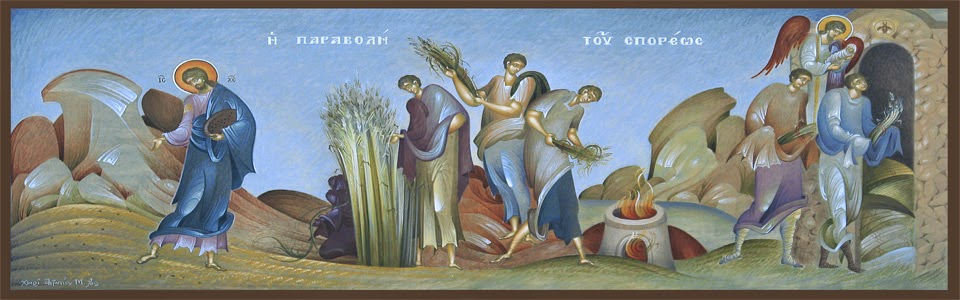
Sod of the Heart

http://www.omhksea.org/2012/10/the-parable-of-the-sower/
Icon by the hand of Antonios Fikos
"And in his sowing, some fell along the road: and the birds came and ate it...[To] all hearing the word of the kingdom and not understanding, the wicked one comes, and snatches what was sown in his heart: this is the one sowed along the road."--Mt 13:4,19

The sowing of the seed in our hearts is not of our doing: what we have control over is what soil we have prepared.  The sower sows freely, and without His sowing our preparation of the soil is ineffective: "How can one believe without hearing?  And how can one hear without a preacher?"  Therefore we must prepare the soil of our hearts well, not letting it become like a road.  Hear what St. Cyril of Alexandria says: "A wayside is almost always hard and unbroken, because it is trodden down by the feet of all those who pass that way, and seed is never sown there.  No sacred or divine word, therefore, will be able to enter those who have minds that are hard and unyielding, for it is by the aid of such words that the joyful fruits of virtue can grow."

Friday, July 4, 2014

The Righteous Rahab


http://www.womeninthebible.net/Rahab-prostitute.htm

"By faith Rahab the harlot did not perish with the disobedient, receiving the spies with peace."--Heb 11:31

"And in the same way was Rahab the harlot not by works justified, receiving the angels, and by a different way sending them out?"--Jas 2:25

Of the many men and women whose lives we read of in the Old Testament, we account many as models of righteous and early types of Christians.  The Letter to the Hebrews has a long list of them: "By faith a better sacrifice Abel rather than Cain brought to God...," and so it continues through so many figures.  It is easy to see the faith of Abel and Enoch, of Noah and Abraham, of Isaac and Jacob, of Moses and Joshua, of the Judges, of David and Samuel, and so many others.  Yet many, I think, miss the harlot listed among the righteous: Rahab of Jericho.

Wednesday, April 30, 2014

The Innumerable Facets of Scripture

http://lambonthealtar.blogspot.com/2011/06/jeremiah-prophet.html
The Holy Prophet Jeremiah

 "'Is not My Word like...a hammer that breaketh the rock in pieces?' (Jer 23:29).  As the hammer splits the rock into many splinters, so will a scriptural verse yield many meanings."--Sanhedrin 34A

These words of the Jewish Midrash reveal an essential truth: the Light within the Scriptures is unfathomable.  Yet how much more incomprehensible is the fullness of the Lord!

Monday, April 14, 2014

The Fruits of Repentance


http://commons.wikimedia.org/wiki/File:Ilyas_Basim_Khuri_Bazzi_Rahib_-_Jesus_Curses_the_Fig_Tree_-_Walters_W59258A_-_Full_Page.jpg

Jesus Curses the Fig Tree (1684) by Ilyas Basim Khuri Bazzi Rahib

"O faithful let us fear the punishment of the fig tree which was dried up for not having borne any fruit; let us offer worthy fruits of repentance to Christ, who grant us His great mercy."
--From the Aposticha of Bridegroom Matins on Great and Holy Monday

When Christ hungered and approached the fig tree, He expected it to be bearing fruit; when it was not, He cursed it.  Just so, the foolish virgins not possessing oil were barred from the feast.  It is as if Christ said to them as He said to the high priests and the presbyters of the people, "For this I say to you that will be taken from you the kingdom of God, and it will be given to a nation producing the fruits of it."  This too will occur to us if we are not watchful, if we are not prepared in a wedding garment when the Lord comes to invite us into His bridal chamber engulfed in light.  Let us beg Him, "Fill the garment of my soul with light," and let us work to enkindle that light in ourselves.  Without an overflowing union with He Who is Light, "we are soulless wood, fruitless and withered, matter which is fit for the unquenchable fire" (St. Symeon the New Theologian).

Tuesday, April 10, 2012

On the Conspicuousness of Christians

I was recently instructed that, as a catechist, I should blend myself into my students, to make myself one of them, in order to make them accept me.  If I was too "different" or too blatant in my Catholicism, I would not be accepted.  Instead, I should work from within them, almost in an undercover way.  The thing is, it is difficult to be undercover when your students know you are teaching them the faith.  I can understand my professor's point: the members of the Church should integrate themselves into society so they can change it from within.  It is not an outside force that will bring change, but a force hidden within, such as hidden yeast leavens dough.  We are to be Trojan horses: we must sneak under their radar and then slowly purify their drinking water with the nectar of the faith.  The problem is this: I do not see this as an effective method.

I apologize if I am being proud: I am just giving my opinion on an issue that directly affects how I should live and teach.  If you have any ideas in this area, please tell me: perhaps your reasons will be more convincing to me than my professor's.

The main issue is that I find conspicuous Christians more the norm among the saints than yeast Christians.  I see more saints acting as armored knights than as wooden horses.  Think of the model of all Christians: Jesus Christ, the Son of God, risen from the dead.  He did not hide His faith: He drove the money-changers from the Temple, He performed miracles with countless witnesses, He preached day after day in the synagogues and the Temple (though His enemies were too cowardly to arrest Him then).  Some might say, "But He was God.  Surely God cannot hide Himself.  But we are only men!"  Have not men done the same, though?  Did not St. Paul rejoice over the countless sufferings he bore for preaching the Gospel openly?  He was even stoned to death in Derbe, yet He continued to preach.  Listen to the list of his troubles:

"Five times I have received at the hands of the Jews the forty lashes less one.  Three time I have been beaten with rods; once I was stoned.  Three times I have been shipwrecked; a night and a day I have been adrift at sea; on frequent journeys, in danger from rivers, danger from robbers, danger from my own people, danger from Gentiles, danger in the city, danger in the wilderness, danger at sea, danger from false brethren; in toil and hardship, through  many a sleepless night, in hunger and thirst, often without food, in cold and exposure" (2 Cor 11:24-27).

 Icon of St. Paul by Andrei Rublev

If he had merely kept his conversion secret and continued to act as the zealous Pharisee and pupil of Rabban Gamaliel that he was, or if he had remained an inconspicuous believer, would he have been put through so much suffering?  No!  But with all his suffering came conversions, countless, countless conversions.  If he were not so blatant in his faith, would he have converted so many?  I cannot say for sure, but I would assume not.

Think of the rest of the apostles as well: all except John the Theologian were martyred for their faith, even the thrice-denying one, Pope St. Peter.  "But they were apostles, personal friends of Christ!" some may respond.  Then recall all the countless martyrs of the early Church, such as the ones remembered in the Roman Canon:

"Ignatius, Alexander, Marcellinus, Peter, Felicity, Perpetua, Agatha, Lucy, Agnes, Cecilia, Anastasia."

Yet some might say, "those were still in the early Church.  Times changed, and so did our way of living the faith."  Does a change in culture mean we hide our faith?  By no means!  In extreme circumstances, some may be called to live underground in order to retain the faith from oppressive governments, but in general, we must not hide our faith: we should rather boast in the Lord!  The Church's record of conspicuous martyrs also does not end with the end of the Apostolic Age: martyrs have continued for centuries and centuries, and not only martyrs to the death, but martyrs to reputation, comfort, and fame.  Even in the past century, we have had Servant of God Óscar Romero, Bl. Jerzy Popiełuszko, Bl. Miguel Pro, and St. Maria Goretti.

 Servant of God Óscar Romero; Blessed Jerzy Popiełuszko

What about those who were not martyrs, but still lived their faith in the sight of all?  There are many: the mendicant orders of St. Dominic and St. Francis, pontiffs such as Leo XIII, Pope St. Pius X, and Servant of God Pope Paul VI (called a "white martyr" for the vicious response to his defense of sexual morality, Humanae Vitae), and workers with the poor such as Servant of God Dorothy Day and Bl. Mother Teresa of Calcutta.  Among the Russians, there is even a group called the yurodivuie, "fools for Christ's sake," such as St. Francis of Assisi, St. Benedict Joseph Labré, and St. Simeon the Holy Fool (St. Simeon Salos).  If the saints are any indication, Christians have never been known for their inconspicuousness.

That leads us back to the practical question: should we lived as conspicuous Christians or not?  In this way we would live not only in imitation of our Saviour Jesus Christ and His holy apostles, but in imitation of countless saints through the millennia.  Though our actions may seem foolish to the world, they are glorious to Christ, such as St. Isidore of Pelusium (St. Isidore Pelousiotes) wrote,

"Imitate the simple garments of Christ.  For if the roughness in apparel here on earth is foolishness, wearing the garment of light in heaven is certainly not" (Epistle 74).

We should not be afraid even if we must suffer for our conspicuousness.  As St. Gregory the Theologian exhorts,

"Teach in the temple, drive out the traders in divine things, be stoned if it is necessary you suffer this" (Oration 38.18).

St. Gregory the Theologian

Some may say that in doing this, in acting conspicuous, we are driving away those who would be converted by us.  We are showing the "radical" side of Christianity, which only a few are called to.  It is true that only some are called to the extent of martyrdom, but all are called to preach with their lives, if not also with their words.  Origen even says that it is better to preach with words we don't fully believe than to hide the faith in our hearts (vid. Exhortation to Martyrdom V).

In the end, is our faith one of private devotion, to be gently shared among others as a slowly creeping moss?  No!  Though some are called mainly to work, with direct preaching being rare, all are called to live openly and boldly for Christ.  As the axiom often mis-attributed to St. Francis of Assisi states, "Preach the Gospel at all times; when necessary, use words."  I believe I am called to be a catechist, though: I am called to be an example of the faith lived out for students to see.  When they see me, should they see a man who is only Christian in his intellect?  Should they not be able to tell if I'm a Buddhist well-trained in Catholic doctrine or a practicing Catholic?  Should they see me as no more than a neutral, politically correct textbook in human form?  By no means!

I will not hide my faith under a bushel basket.  When I teach, and even in general when I live, I will wear my faith on my sleeve (literally, in a sense, with my komboskini).  I will not hide my faith and water down my Christian life in order to appeal to the masses.  Should I dilute my Catholicism in order to convert others?  Then what am I converting them to but a crippled version of the faith, a version crippled by my "politically correct" witness?  Like the saints, who converted millions in their Christian zeal, I, too, will strive to live my faith as openly and zealously as possible in the hopes of converting my students.  The fight for conversion is a war, a war "not against flesh and blood, but against the principalities, against the powers, against the world rulers of this present darkness, against the spiritual hosts of wickedness in the heavenly places" (Eph 6:12).  It is a war of the City of God against the City of Man, as in St. Augustine's De Civitate Dei, a war of the culture of life against the culture of death, as in Pope Bl. John Paul II's Evangelium Vitae.  Some may be called to hide themselves amongst the enemy troops in hopes of gaining conversions, but I will be a warrior against the enemy, as the countless saints before me have been.  I will be a conspicuous Christian.  And if I suffer for my convictions, for my true living of the faith, then praise God!  (How I hope I can keep that sentiment when the day of suffering comes!)  Then I just fulfill the dictum of St. John Climacus:

"War against us is proof we are making war" (Ladder, Step IV).

I am sorry for my rampant pride through this post.  I merely wish to express my convictions on this matter.  Please listen to my message, though it may be clothed in the words of pride.  May each of those moments of pride merely reinforce the fact that I am a sinner in need of mercy.  God Bless.

 St. Simeon Salos, pray for us!


Nota Bene: Information from this post comes from Wikipedia (Text and rubrics of the Roman Canon, Foolishness for Christ, and above-sourced articles).  Sergius Bolshakoff's Russian Mystics also gave me information on yurodivuie.  The quote from St. Isidore Pelousiotes is from Nicodemus the Hagiorite's A Handbook of Spiritual Counsel, Chapter VIII, translated by Peter A. Chambers.  The quote from St. Gregory the Theologian comes from Sr. Nonna Verna Harrison's translation of his Festal Orations.  The quote from St. John Climacus comes from his Ladder of Divine Ascent, translated by Colm Luibheid and Norman Russell.
 

Text ©2012 Brandon P. Otto.  Licensed via CC BY-NC.  Feel free to redistribute non-commercially, as long as credit is given to the author.