Showing posts with label St. Ambrose of Milan. Show all posts

Monday, April 22, 2024

Christ the Awaited Man Carries Us to the Baptismal Pool, Troubled by the Spirit

Christ is risen!

Today is the Sunday of the Paralytic, when we read the story of the pool of Bethesda, or the "Probatic Pool" (as the Douay-Rheims has it, the pool "by the Sheepgate").  It is an example of Jesus' healing miracles; it is an example of His breaking the Sabbath; it is an example of His mercy for the over-looked.  (It would be easy to read this pericope as a rebuke of "survival of the fittest": the pool only healed the one who got there first, who either was less ill or could hire faster bearers.)  Striking, though, is that odd description of the working of the pool: "For an angel of the Lord, according to season, descended into the pool and troubled the water; then the first one entering after the troubling of the water became healthy from whatever illness he had" (Jn 5:4).  Many early Greek manuscripts omit this verse, and modern translations do as well (as some also do with the stoning of the woman caught in adultery in Jn 8), but it has a long history and tradition of being included in the Scriptures.

In itself, it seems like a bit of folklore, expanding upon the paralytic's later statement about needing to enter the water once it is stirred (Jn 5:7).  Yet the fact that this folklore was incorporated into Scripture—whether by the evangelist himself or by an early editor or compiler—gives it inspired meaning, and the Fathers have sought that meaning, and they have often found it in Baptism.

It is common to refer to the Baptismal font by the name "pool," specifically, the Greek κολυμβήθρα (kolymbēthra), the same name used in this Scripture passage.  Thus, speaking of how Christ's Baptism reflected our own, St. Proklos of Constantinople says that "In the river, He sketched the pool's mystery" (Oration 2.2).  Yet some go further than this simple word, and they connect this whole pericope to Baptism.

So St. Ambrose does, in his twin works On the Sacraments and On the Mysteries.  (For a brief introduction to these works, see my recent post "St. Ambrose's Foot-Washing Rebellion.")  He finds many figures of Baptism in Scripture, the four main ones being these: in the story of Naaman being cleansed in the Jordan (2 Kgs 5), "you have one Baptism, another in the flood, you have a third kind, when the fathers were baptized in the Red Sea, you have a fourth kind in the pool, when the water was troubled" (On the Sacraments II.III.9).  (The Byzantine readings for the Vigil of Theophany include the first and third of these figures.)

All four of these, of course, involve some kind of passage through water: Naaman and the pool of Bethesda include actual immersion in the water, while the Flood and the Red Sea involve being protected from the water.  Yet the Flood has Apostolic warrant for being a prefigurement of Baptism: "in [the ark], few, that is, eight souls, were saved through water.  And the antitype, Baptism, now saves you..." (1 Pet 3:20-21).  For, though the saved were not themselves immersed in the water, yet they were saved through the water, because the water destroyed the wicked—be it all the wicked of the world (in the Flood), be it just Pharaoh and his chariots and his charioteers (in the Exodus)-—and freed the saved from their grasp.

(Other figures Ambrose finds include Elisha's submerged axe, where tossing the wooden handle into the water caused the iron to float back up (2 Kgs 6), as well as the wood tossed in the bitter water of Marah to make it sweet (Ex 15:23ff).  Both of these are also found in the Byzantine readings for the Vigil of Theophany.  On these figures, see Ambrose, On the Sacraments II.IV; on Marah, see also On the Mysteries III.14.  Interestingly, Ambrose also uses these same figures—among others—to argue for the truth of transubstantiation: see On the Mysteries IX and On the Sacraments IV.IV.)

But to return to the pool of Bethesda: although—as I mentioned in my previous post—St. Ambrose's On the Mysteries is often seen as a cliff-notes version of the longer and more developed On the Sacraments, there are sometimes differences in emphasis and interpretation between the two, and that applies in this passage.  Both apply the episode of the troubled water to the Baptismal pool, but in quite different ways.

First, the applicable passage from On the Sacraments (II.II):

"3. What was read yesterday?  'An angel,' it says, 'according to time, descended into the pool, and, whenever the angel descended, the water was troubled; and he who first descended was cured from every languor by which he was held' (Jn 5:4).  Which signifies a figure of the coming of our Lord Jesus Christ.

4. Why an angel?  For He is the Angel of great counsel (cf. Is 9:6).  'According to time,' since He was reserved until the last hour; so that, in that setting, He would seize the day, and defer the setting.  Therefore, 'whenever the angel descended, the water was troubled.'  Perhaps you say: 'Why is it not moved now?'  Do you hear why?  A sign to the incredulous, faith to the believing (cf. 1 Cor 14:22).

5. 'He who first descended, was cured from every infirmity.'  He who is first in time, or honor?  Understand both.  If in time, he who first descended was healed before, that is, the people of the Jews before the people of the nations.  If in honor, he who first descended, that is, who had the fear of God, the study of justice, the grace of charity, chastity’s affection; he is better healed.  Yet, at that time, one was healed—at that time, I say, in figure, he who first descended, he alone was cured.  How much greater is the grace of the Church, in which all who descend are saved?

6. But see the Mystery.  Our Lord Jesus Christ came to the pool, many sick lay there.  And easily did many sick lay there, where only one was cured.  Then He said to that paralytic: Descend.  He said: I have no man (Jn 5:7).  See where you are baptized.  Whence is Baptism, except from the Cross of Christ, from the death of Christ?  There is all Mystery, since He suffered for you.  In this you are redeemed, in this you are saved.

7. I, he says, have no man; that is, since through man is death, and through man the resurrection of the dead (1 Cor 19:21).  He could not descend, he could not be saved, who did not believe that our Lord Jesus took flesh from the Virgin.  But here, he who awaited the mediator of God and men, the man Jesus Christ, expecting Him of whom it is said, And the Lord will send a man who will make you saved (Is 19:4), he said: I have no man; and, therefore, he merited to attain healing, since he believed in the One Who was to come.  Yet better and more perfect would it be, if he now believed that He Whom he hoped was to come had come."

Though there is a slight connection here between the pool of Bethseda and the Baptismal pool, the main focus is, instead, on salvation as a whole, salvation which came through Christ.  The sick who lay around the pool were waiting for an angel: though many did not know it, the one they were really waiting for was the Angel of Great Counsel, Jesus Christ.  This angel would bring salvation to all, not just to one; He would bring salvation to both Jews and Gentiles, not Jews alone.  But the sick need not just the water-troubling angel: they also needed a man to carry them down to the pool, and the real man they waited for was the "man who will make you saved," Jesus the God-Man.  (On the idea of Jesus carrying us to salvation, consider the Good Samaritan, as commonly interpreted by the Greek Fathers; the modern Christian might instead suffer the intrusive thought of the saccharine "Footsteps" poem.)  The only link to Baptism is the fact that Baptism comes through the Cross of Christ, and, thus, through Christ Himself, the angel and the man who were awaited at Bethesda.

Yet, when we turn to On the Mysteries, we find a startlingly different interpretation, one that has its eyes set like flint on Baptism.  The applicable passage from On the Mysteries (IV) reads:

"21. ...Believe that these are not empty waters.

22. Therefore, it is said to you: For angel of the Lord descended, in its time, into the swimming pool, and the water was moved, and whoever first descended into the swimming pool after the moving of the water, became healed from whatever languor he was held by (Jn 5:4).  This pool was in Jerusalem, in which one soul was healed: but no one was healed before the angel descended.  So that it would be indicated that the angel had descended, the water was moved, for the incredulous.  A sign for them, faith for you; the angel descended for them, the Holy Spirit for you; a creature was moved for them, Christ Himself, the Lord of creatures, works for you.

23. Then, one was cured, now, all are healed, or, certainly, one sole Christian people; for, in other places, there is even deceitful water (cf. Jer 15:18).  The baptism of the perfidious does not heal, nor wash, but pollutes.  The Jew baptizes pitchers and chalices (cf. Mk 7:4), as if insensible things could receive either fault or grace.  You, here, baptize your sensible chalice, in which your good works shine, in which your grace’s splendor is refulgent.  And, therefore, that pool was in figure, so that you would believe that, into the font here, divine power descends.

24. Therefore, that paralytic awaited a man (cf. Jn 5:7).  Who was that, except the Lord Jesus, born from the Virgin, by Whose advent, now, a shadow does not cure individuals, but truth cures all?  He is, therefore, the One expected to descend, of Whom God the Father spoke to John the Baptist: Over Whom you will see the Spirit descending from heaven, and remaining over Him, He is the One Who baptizes in the Holy Spirit (Jn 1:33).  Of which John testified, saying: For I saw the Spirit descending from heaven like a dove and remaining over Him (Jn 1:32).  And why did the Spirit descend here like a dove, except so that you would see, except so that you would know that even that dove, which Noah the just sent out from the ark (cf. Gen 8:8), was the appearance of this dove, so that you would know the type of the Sacrament?

25. And perhaps you say: 'While that which was sent out was a true dove, here One "like a dove" descended: why do we say that was the appearance, this the truth, when, according to the Greeks, it is written that the Spirit descended "in the appearance of a dove"?'  But what is as true as the divinity which remains forever?  Yet a creature cannot be truth, but appearance, which is easily dissolved and changed.  Likewise, the simplicity of those who are baptized ought to be, not in appearance, but truth.  Whence the Lord also says: Be astute as serpents, and simple as doves (Mt 10:16).  Therefore, He worthily descended like a dove, so that He would admonish us that we ought to have the simplicity of doves.  But we read the appearance and are to accept it as true also about Christ—And He was found in appearance as a man (Phil 2:7)—and about God the Father—Nor have you seen His appearance (Jn 5:37)."

(First, a quick note on the wording of Jn 5:4 in §22: the generally-accepted Vulgate text of this verse uses the word piscina for "pool."  But Ambrose here—matching a 6th-century Milanese manuscript of the Vulgate—instead uses the word natatoria, related to the verb nato, "I swim."  To emphasize the distinction, I have translated it "swimming pool" here.)

We see some similarities to the treatment in On the Sacraments: the man who was awaited was Jesus; "a sign for them," the incredulous, "faith for you," the believers (cf. 1 Cor 14:22).  But, here, the Holy Spirit dominates the discussion, He Who was absent from the treatment in On the Sacraments.

The One Who "troubles the waters" of the Baptismal pool is the Holy Spirit.  (Similarly, He is the One Who "is borne above the waters" (Gen 1:2), and "Did He Who was borne above not work?  Know that He worked in that fabrication of the world..."  Likewise, He works here, when He is borne above the Baptismal pool, for this Mystery is "prefigured in the origin of the world itself."  See On the Mysteries III.9.)  By the working of the Holy Spirit and of Christ, these waters become truly saving waters.  Our Baptisms are not just meaningless washings, like the ceremonial washings performed by the Jews; nor are our waters "deceitful," so that they pollute instead of healing.  (Probably the "baptism of the perfidious" was a reference to a heretical group with invalid Baptisms, though it's possible it's a reference to the Jewish washings Ambrose discusses next: recall the infamous epithet of the "perfidious Jews" in the Roman Good Friday service.)

The expectation of the coming of Jesus is also linked to the Holy Spirit, for, in His Baptism, the Holy Spirit descended like a dove, recalling Noah's dove, and, in this recalling, making the Flood a type of Baptism.  And this "likeness," this "appearance" of a dove, does not deny the Holy Spirit's true presence, either at Jesus' Baptism or, consequently, at our own.  By His true presence, a true regeneration is effected: "If the Holy Spirit, coming upon the Virgin, worked the conception, and fulfilled the duty of generation, certainly, it is not to be doubted that, coming over the font, or over those who acquire Baptism, He works the truth of regeneration" (Mysteries IX.59).

It is only by the Spirit's coming, by the Spirit's "troubling the water," that the water becomes salvific.  "You saw the water, but not all water heals; but that water heals which has the grace of Christ.  One is the element, another the consecration: one the work, another the working.  Water is the work, the Holy Spirit’s is the working.  Water does not heal, unless the Spirit descends, and consecrates that water" (Sacraments I.V.15).  Though we do not see the Spirit descend, that does not mean He is not there.  "A sign to the incredulous, faith to the believing" (Sacraments II.II.4).  He appeared "bodily" at Christ's Baptism; He appeared much more bodily at Pentecost, in the tongues of flame, where He "willed to demonstrate Himself, even bodily, to the incredulous, that is, bodily through a sign, spiritually through a Sacrament...since, in the beginning, signs were done for the incredulous, now, for us, in the fullness of the Church, truth is to be gathered, not by a sign, but by faith" (Sacraments II.V.15).  

So, though we do not see the water moved now, we believe that the Holy Spirit works in Baptism, being borne over the waters, troubling them, when He responds to the priest's invocation, and, in this troubling, He makes the waters able to save, able to heal.  But this working of the Holy Spirit, emphasized more in the passage from On the Mysteries, does not conflict with the emphasis on Christ's role in Baptism in the passage from On the Sacraments.  "In all which we do, the mystery of the Trinity is preserved.  Everywhere is the Father and the Son and the Holy Spirit, one operation, one sanctification" (Sacraments VI.II.5).  For the Spirit is not separate from the Father and the Son: there is one and "the same Holy Spirit, the same Spirit of God, the same Spirit of Christ, the same Spirit Paraclete" (Sacraments VI.II.9).

In sum, Ambrose's two interpretations of the Pool of Bethseda in the context of Baptism do not conflict, but rather cooperate.  For Christ, though also the Angel of Good Counsel, is truly the awaited man who will carry the sick to the pool, "the man who will make you saved" (Is 19:4).  Before His coming, we said, like the paralytic, "I have no man"; now, we have a man, the Man-God and God-Man.  He will carry us down to that pool which is now troubled, not by an angel, but by a descending, flaming dove, by the Holy Spirit Who, being borne over the waters, works upon them.  And all is in accord with the Father's plan, the Father's blessing, the Father's prefiguring.  "Everywhere is the Father and the Son and the Holy Spirit, one operation, one sanctification" of this pool of ours, this "laver of regeneration" (Tit 3:5), this new and better Pool of Bethesda, open, not just "in season," but always, open, not just for "the first man," but for all men, open, not just to heal bodies, but to heal souls. 

Source: St. Ambrose's On the Mysteries can be found in PL 16:389-410, and On the Sacraments can be found in PL 16:417-462.

Text and Translations ©2024 Brandon P. Otto.  Licensed via CC BY-NC.  Feel free to redistribute non-commercially, as long as credit is given to the author and translator.

Saturday, March 30, 2024

St. Ambrose's Foot-Washing Rebellion

 In English, Holy Thursday is traditionally known as Maundy Thursday, that is “Commandment Thursday” (maundy coming from the Latin mandatum, “commandment”). For this day is the day that Christ gave His Apostles a commandment, and not just the commandment of the Eucharist, but a commandment of love: “A new commandment I give to you, that you love each other, even as I have loved you” (Jn 13:34).1

Though this commandment is given later in the Last Supper, as Jesus is beginning His long Johannine discourse, it is typically linked back to the foot-washing at the beginning of John 13, where Jesus similarly declares “If I, therefore, the Lord and master, have washed your feet, you too ought to wash one another’s feet. For I have given you an example so that, just as I have done to you, so you, too, should do” (Jn 13:14-15). So the “Maundy” of Maundy Thursday is taken to mean the commandment of foot-washing, of service, of love, rather than the commandment of the Eucharist.

A Holy Thursday foot-washing has long been a practice in the Roman Church—and occasionally in the Orthodox Churches—in emulation of Jesus’ example. But it need not be a once-a-year event: the early Christians went out and washed the feet of the poor throughout the year, as an act of service and humility, a practice that Pope Francis recalls when he takes the Holy Thursday foot-washing outside the church, into prisons and other places.

Foot-washing, then, can be a liturgical re-enactment of Christ’s acts at the Last Supper, and it can be a non-liturgical act of service. But it can also have another liturgical use, though rare, and it is best represented by St. Ambrose.

St. Ambrose was Bishop of Milan, mentor and baptizer of St. Augustine (and the one who taught him how to read silently),2 and a prolific writer—and even more prolific if one counts all the later works stamped with his name, such as the Pauline commentator known as “Ambrosiaster.” Milan was a stubborn town, liturgically, so much so that, even after the Council of Trent, they kept their own liturgical rite, the Milanese Rite, better known as the Ambrosian Rite.

Under Ambrose’s name, we have two mystagogical works, sermons giving to the neophytes, the newly-baptized, explaining the meaning of the rites they had experienced at the Paschal Vigil.3 Whether these works were written for publication or were merely notes put together by listeners is unclear; certainly the shorter of the two works—On the Mysteries—seems more cliff-note-like, while the much longer work—On the Sacraments—seems more likely geared for publication. Both cover the same general topics, though with some different emphases and details, so it is assumed that, if they are based on courses of sermons St. Ambrose gave, that they are based on two different years’ sermons.

These two works, along with other mystagogical works, are key sources for learning about the liturgical rites of the Fathers’ time, including its regional differences. Among such differences is foot-washing during the rite of Baptism.

On the Mysteries only half-discusses this ritual. He mentions how the neophyte “ascended from the font, with the Evangelic reading having been brought to mind” (VI.31). This reading is that of the washing of the apostles’ feet, and, in it, Peter “did not notice the Mystery, and, therefore, he denied the ministry, since he believed that, if he patiently accepted the Lord’s yielding to him, it would weigh down the servant’s humility” (VI.31). Yet Jesus rebuked him, and declared that, in order to be all clean, Peter had to have his feet washed—but only his feet, not his hands and head. So, too—it is implied—the one who is baptized has had the head and hands of his soul washed: all that remains is the washing of his feet. So Ambrose pleads the neophyte to “recognize that the Mystery consists in that same ministry of humility... For when the Author of Salvation redeemed us through obedience, how much more ought we, His servants, to exhibit the yieldingness of humility and obedience!” (VI.33)

The neophyte, then, had his feet washed after his Baptism (after he “ascended from the font”), as an example of humility and obedience. But there is something else here: this foot-washing is described as a mystery. Byzantine ears perk up at this, for Mystery is what we call a Sacrament. We can see this in the parallel titles of Ambrose’s two works: On the Mysteries and On the Sacraments cover the same topic. Is Ambrose saying, then, that foot-washing is a Sacrament? (Some Orthodox have said so throughout the centuries.) The hints in this cliff-note text are small, but the issue is clear when we turn to On the Sacraments.

Here, Ambrose makes clear what happens: “You ascended from the font, what followed? You heard the reading. The high priest being girded...he washed your feet” (III.1.4). Again, this is called a Mystery, and a wondrous one: “See all justice, see humility, see grace, see sanctification: Unless I wash, He says, your feet, you will not have My part (Jn 13:8)” (III.1.4).

But here Ambrose goes further, discussing, not just the Mystery itself, but how others view it: “We are not ignorant that the Roman Church does not have this custom, she whose time and form we follow in everything: yet she does not have this custom, that she washes feet. See, then, perhaps she declined because of the multitude [of neophytes]. Yet there are those who say—and try to excuse [her]--that this is not to be done in a Mystery, not in regeneration, but that feet are to be washed like guests. One is of humility, the other of sanctification. Therefore, hear that it is a Mystery and sanctification: Unless I wash your feet, you will not have My part (Jn 13:8)” (III.1.5). He boldly affirms that what he is doing is not what Rome does: here he refuses to comply. This refusal not just the stubbornness of local tradition, but a principled refusal: to remove the foot-washing from the Baptismal rite is to deny the theology.

In On the Mysteries, the foot-washing is mainly discussed as an example of humility and “yieldingness” (the root Latin term used in that passage is obsequium); here, it is specifically not mere humility. Washing the feet “like guests” is an act of humility (one that, I think, Ambrose would approve of in other contexts); here, though, it is an act of sanctification.

But, why? Is not Baptism sanctification enough? “In Baptism, all fault is washed away” (III.1.7); “for our own [hereditary sins] are unloosed in Baptism” (Mysteries VI.32). How can foot-washing be required on top of this? The key, for Ambrose, is Peter’s back-and-forth with Christ, where Jesus clarifies that Peter only needs his feet washed, not his hands and head. Why? Because “since Adam was supplanted by the devil (cf. Gen 3:6), and he poured forth venom on his feet, therefore, you wash feet, so that, to that part for which the serpent waited in ambush, the help4 of greater sanctification might come, because which, afterwards, he cannot supplant you” (Sacraments III.I.7).

We could view this in two ways: first, the feet may be getting an extra aid (“greater sanctification”), since they represent where the devil constantly waits to strike us; second, this washing may be a completion of the Baptismal washing. Perhaps, in Ambrose’s practice, a Baptism was not a full-body immersion: maybe it was only a dunking of the head, arms, and torso. In that case, the feet remained “unbaptized,” and so the sacramental foot-washing was necessary.

Whichever the case was, Ambrose certainly saw his foot-washing as sacramental and necessary, with Jn 13:8 as the proof text. So necessary was it to him that he even dared to defy Rome. “In everything, I desire to follow the Roman Church, yet we, men, also have sense; therefore, what is rightly preserved elsewhere, we also rightly keep” (III.1.5). As if that wasn’t enough, he claims the Petrine link: “We follow the apostle Peter himself, we cling to his devotion. How does the Roman Church respond to this? Certainly, the author of this assertion of ours is Peter the apostle, who was a priest of the Roman Church” (III.1.6).

How long did this stubbornness hold out after Ambrose’s death? Quite a while, it seems: some Ambrosian Rite sacramentaries of the 11th and 12th centuries include the post-Baptismal foot-washing.5 A 1640 Missale Ambrosianum, though, simply mentions that the baptizands are to be baptized “in the accustomed way,” with no further details given.6 The Catholic Encyclopedia’s entry on the Ambrosian Rite, which includes a brief summary of the order of Baptism, has no mention of foot-washing.7 I’ve not yet gotten my hands on a modern Ambrosian missal, but it seems likely the foot-washing was eventually removed, and St. Ambrose’s rebellion against Rome quashed. (Perhaps St. Charles Borromeo’s reform of the rite had something to do with it? Obviously, this is just speculation.)

All in all, the episode of St. Ambrose and the foot-washing rebellion is a quirk of liturgical history, though one that does prod us to think further on Jesus’ words: Unless I wash your feet, you will not have My part (Jn 13:8). Did He say this merely to the Apostles, or did He say it to us as well? If to us, how does He wash our feet today, and what part of His would we lack without it?

Murky thoughts for a Maundy day.


1A bit of a Ruthenian in-joke here: the switch-over from the 1970s liturgical translation (the “Blue Book”) to the 2000s translation (the “Green Book”) included some fairly minor changes in very well-known texts. So now, at Pascha, Christ “tramples” death instead of “conquering” it, and He now saves those in the “tombs,” rather than the “graves.” A similar issue happened with this Gospel verse, which became the text of a popular paraliturgical hymn. The translation I gave above is the currently-used one; the Blue Book version reads “This new commandment I give to you, that you love one another, just as I have so loved you.” My first parish—due to an indult—still used the Blue Book texts after the Green Book was released, so those were my first Byzantine translations. Though I’ve adapted to the new version of the Paschal troparion, I still get tripped up by “This/A new commandment” every time we sing it.

2See St. Augustine, Confessions VI.3: “But when he read, his eyes were led through the pages and his heart probed the meaning, but his voice and tongue lay still. Often, when we were present...we thus saw him reading, quietly and never elsewise, and sitting in long-lasting silence.”

3For a bit more on the concept of mystagogy, see my article “The Awe-Inspiring Mysteries: The Importance of Mystagogy,” Homiletic & Pastoral Review, 8/09/2015, https://www.hprweb.com/2015/08/the-awe-inspiring-mysteries/. My undergraduate seminar analyzed the mystagogical works of St. Ambrose, St. John Chrysostom, St. Cyril of Jerusalem, and Theodore of Mopsuestia.

4 More literally, the term subsidium often refers to a reserve of troops, which fits well with the description of Satan “lying in ambush.”

5I’m taking this information second-hand, from Gene Finnegan, “Ambrosian liturgical texts,” 4/05/2023, https://memoriesofan80yearoldguy.home.blog/2023/04/05/ambrosian-liturgical-texts/ (accessed March 29, 2024).

6Missale Ambrosianum (Milan: Jo. Ambrosium Sirturum, 1640), 167. Confusingly, the volume is divided into two, separately-paginated sections. This reference is to the second section.

7See H. Jenner, “Ambrosian Liturgy and Rite,” in The Catholic Encyclopedia, Volume I (New York: Robert Appleton Company, 1907), reprinted at https://www.newadvent.org/cathen/01394a.htm (accessed March 30, 2024).


 Note: The cited passages from St. Ambrose can be found in PL 16:398B-399A (On the Mysteries) and PL 16:432B-433C (On the Sacraments).


Text ©2024 Brandon P. Otto.  Licensed via CC BY-NC.  Feel free to redistribute non-commercially, as long as credit is given to the author.


Wednesday, February 22, 2023

St. Ambrose: The Power of Fasting

Great is the power of fasting.  Moreover, so beauteous is its bravery that fasting delights even Christ: so strong, that it leads men to heaven.  And, to use human rather than divine examples, a voice sent forth from the mouth of the fasting Elijah closed heaven, due to the sacrilege of the people of the Jews (1 Kgs 17:1).  So, too, when an altar to an idol was set up by King Ahab (1 Kgs 16:32), at the word of the prophet, for three years and six months, the dew of rain did not fall upon the earth.  A worthy punishment which fittingly restrains intemperance: that heaven would be closed to the impious who polluted earthly things.  Worthy, indeed, that, at the condemnation of the king’s sacrilege, the prophet was sent to the widow in Sarepta of Sidon, who, since she offered devotion through food, merited that she alone would not feel the distress of the public aridity.  Therefore, the jug of barley did not lack, when the torrent’s flows were lacking (1 Kgs 17:8-16).

What will I weave from the rest?  Fasting, he revived the son of the widow from the realms below (1 Kgs 17:17-24); fasting, he put away the rains by speech (1 Kgs 17:1); fasting, he brought fire forth from heaven (1 Kgs 17:36-38; 2 Kgs 1); fasting, he was snatched up to heaven in a chariot (2 Kgs 2:11); and, by a fast of forty days, he acquired the divine presence (1 Kgs 19).  Therefore, the more he fasted, the more he merited.  By fasting, he made the flows of the Jordan stand still by speech, and, with a dusty footstep, he crossed the overflowing riverbank, suddenly dry (2 Kgs 2:8).  With merit, the divine sentence judged him worthy of heaven, so that he was snatched up in his body, since he lived a celestial life in the body, and exhibited a supernal manner of conversation on earth.

For what is fasting, except the celestial substance and image?  Fasting is the refection of the soul, the food of the mind is fasting, the life of angels is fasting, fasting is fault’s death, the excision of offenses, the remedy of salvation, the root of grace, it is the foundation of chastity.  By this ladder, one more quickly attains to God; by this ladder, Elijah ascended, before he ascended in the chariot.  Departing for heaven, he left this inheritance of sobriety and abstention to his disciple.  In this power and spirit--that of Elijah--John came.  Therefore, in the desert, he also spent his time in fasting.  But his food was locusts and wild honey (Mt 3:4; Mk 1:6).  And, therefore, since he was bypassing the possibility of human life through continence, he was esteemed as, not a man, but an angel.  Of him we read: Indeed, he is more than a prophet.  He is the one of whom it is written: Behold, I send My angel before your face, who will prepare your way before you (Mt 11:9-10; Mal 3:1).  Who could, by human power, ascend with fiery horses, in fiery chariots, guiding bronze chariots, except he who changes the nature of the human body into an incorruptible nature through the power of fasting?

Nota Bene: The above passage is from St. Ambrose's On Elijah and Fasting II.2-III.4 (PL 14:698A-699C).  In the first paragraph, "bravery" translates the Latin militia, more specifically meaning "military spirit" or "military courage."  

Translation ©2023 Brandon P. Otto.  Licensed via CC-BY-NC. Feel free to redistribute non-commercially, as long as credit is given to the author.

Friday, June 20, 2014

The Levites' Portion

http://iconsofthefaith.com/li.htm 
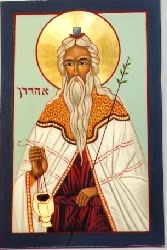
Holy Prophet Aaron the High Priest

"Then the Lord said to Aaron, 'And behold, I have given you whatever is kept of the offerings made to me, all the consecrated things of the people of Israel; I have given them to you as a portion, and to your sons as a perpetual due."--Num 18:8

Out of the twelve tribes of the Israel, the descendants of the sons of Jacob, the Lord chose one to be His own.  For He said, "The Levites shall be mine: I am the Lord" (Num 3:44).  Levi was not among the msot beloved sons of Israel, for of him and his brother Simeon his father said, "Weapons of violence are their swords.  O my soul, come not into their council; O my spirit, be not joined to their company; for in their anger they slay men...I will divide them in Jacob and scatter them in Israel" (Gen 49:5-7).  Yet despite the violent nature of Levi, his descendants were not always so.  While Moses may have been a man of anger at times, Aaron was the servant of God who knew how to speak well, as his brother declared, and to him and his sons the Lord bestowed a great blessing.  For to them were entrusted the holy things.

Friday, June 6, 2014

"Guide Me in the Way Everlasting"

http://www.art-breastfeeding.com/rel1/v3.htm
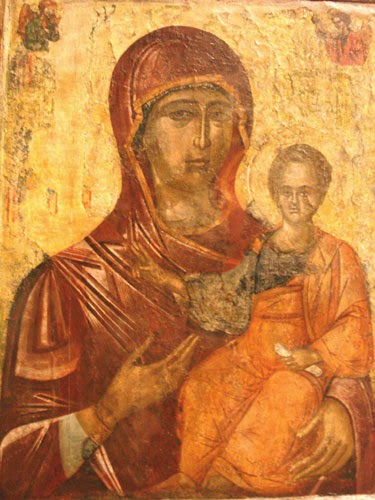
 A Hodigitria Icon, an icon of She Who Guides, from the National Museum of Art in Bucharest, Romania

"And see if a lawless way is in me, and guide me in the way everlasting."--Ps 138:24

The way of the Lord is an everlasting way, for He is everlasting, and if we hope in Him, we too shall become everlasting, for we shall have no end to joy.  If we trust in the Lord, an eternal Heaven awaits us, the eternal liturgy where men of all tribes and tongues and races and nations will praise the Lord unceasingly.  The way to this eternal liturgical rest is what we ask from the Lord in this psalm.

Wednesday, April 16, 2014

Upon Moses' Chair


A replica of the Chair of Moses found at the Synagogue in Chorazin

"Upon Moses' chair sit the scribes and the Pharisees: all things whatsoever they tell you to keep, keep and do: but their works do not do, for they speak and do not do."--Mt 23:2-3

How great was Moses' authority, that even his chair continues to be reverenced millennia after his falling asleep!  God ordained him to be the lawgiver of the Israelites and to guide them in the commandments of the Lord, and his authority succeeded him throughout the ages.  First it passed to Joshua, the prototype of Christ in name, then to the many judges the Lord raised, then to the kings of Israel and Judah through the mediation of Samuel, and then to the elders and the teachers after the Exile.  Jesus Himself affirmed this succession of authority, for He affirmed that even the hypocritical scribes and Pharisees had an authority to be heeded.  If even they, successors of the prophet and lawgiver Moses, were to be heeded, how much more the successors of the honorable and glorious apostles?

Monday, April 14, 2014

The Fruits of Repentance


http://commons.wikimedia.org/wiki/File:Ilyas_Basim_Khuri_Bazzi_Rahib_-_Jesus_Curses_the_Fig_Tree_-_Walters_W59258A_-_Full_Page.jpg

Jesus Curses the Fig Tree (1684) by Ilyas Basim Khuri Bazzi Rahib

"O faithful let us fear the punishment of the fig tree which was dried up for not having borne any fruit; let us offer worthy fruits of repentance to Christ, who grant us His great mercy."
--From the Aposticha of Bridegroom Matins on Great and Holy Monday

When Christ hungered and approached the fig tree, He expected it to be bearing fruit; when it was not, He cursed it.  Just so, the foolish virgins not possessing oil were barred from the feast.  It is as if Christ said to them as He said to the high priests and the presbyters of the people, "For this I say to you that will be taken from you the kingdom of God, and it will be given to a nation producing the fruits of it."  This too will occur to us if we are not watchful, if we are not prepared in a wedding garment when the Lord comes to invite us into His bridal chamber engulfed in light.  Let us beg Him, "Fill the garment of my soul with light," and let us work to enkindle that light in ourselves.  Without an overflowing union with He Who is Light, "we are soulless wood, fruitless and withered, matter which is fit for the unquenchable fire" (St. Symeon the New Theologian).

Wednesday, April 2, 2014

The Answer of the Tongue

http://www.macdougallauction.com/Indexx.asp?id=17720&lx=a
Holy Prophet King Solomon, traditional author of Proverbs

"To man are the preparations of the heart:
from the Lord is the answer of the tongue."
--Prv 16:1

The Lord holds sway over all: with Him is all power, and for this we call Him Pantokrator, All-Mighty.  Heaven and earth and all their inhabitants are under His command, for "the earth is the Lord's and the fullness thereof, the world and those who dwell therein," and "He stretches forth the heavens like a tent," a tent which He can set up and take down at will.  If He wills, He could wipe out man from the face of the earth, as in the time of Noah, yet instead He wills that we work out our salvation in fear and trembling in this world.  Though He does not use His power in its most sweeping way, He still has all power over all created things, down to the smallest speck, and He watches over all and cares for all, as He even numbers each hair on our heads.  Thus He has rule even over the answers of our tongues.